Ten years ago, Manju and Avinash had not fallen in love.
They had been introduced.
Their families had called it a match.
The elders had called it an alliance.
And the businessmen in both families had quietly called it a good deal.
Both families owned successful businesses. There was trust between them, mutual respect, and, most importantly, the marriage would strengthen ties that had already been profitable for years.
So, when Manju and Avinash were told they were getting married, neither of them was really asked whether they wanted to.
They were asked whether they had any objections.
Neither had.
At twenty-two, Manju had been too confident to be frightened by the idea of marrying a man she barely knew.
Avinash had been too reserved to say that he was frightened at all.
The wedding was grand.
The photographs were beautiful.
Everyone said they looked perfect together.
They were wrong.
Not immediately.
For the first few years, they managed.
They were polite to each other. They learned each other’s routines. They had children. They attended family functions together, smiled for photographs, hosted business dinners and played their respective roles perfectly.
But underneath it all was a fundamental problem.
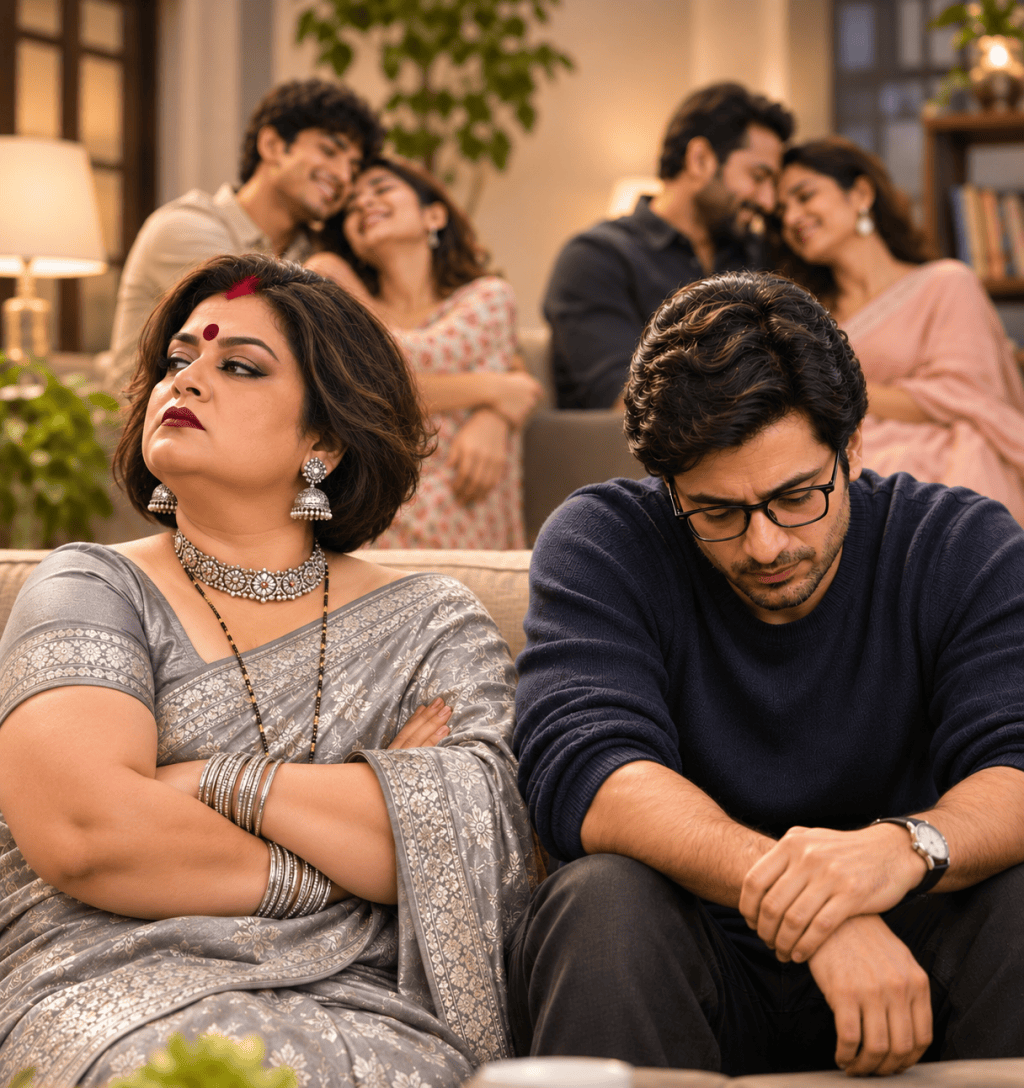
They were completely different people.
Manju was fire.
She was loud, bold, impulsive and adventurous. She spoke her mind before deciding whether it needed to be spoken. She loved crowded restaurants, loud music, spontaneous road trips and arguing simply because she enjoyed the thrill of winning.
Avinash was quiet water.
He liked books, classical music, peaceful evenings and long conversations that didn’t require raised voices. He thought before speaking and often thought again after speaking.
Manju thought Avinash was dull.
Avinash thought Manju was exhausting.
Neither said it quite so simply.
Instead, they fought about everything.
The temperature of the air conditioner.
The restaurant they would eat at.
The music playing in the car.
How the children should be disciplined.
Whether a holiday needed an itinerary.
Whether an evening needed silence.
Even their idea of relaxation was opposite.
Manju wanted to go out.
Avinash wanted to stay home.
Manju wanted people around.
Avinash wanted space.
For years, the joint family acted as a buffer.
There were always parents, siblings, cousins, servants, business associates and relatives moving around the house. Their disagreements rarely had enough privacy to become disasters.
Then, a year ago, they moved into their own house.
Everyone thought it would be wonderful.
For the first time, they would have privacy.
Instead, the walls became witnesses.
Their arguments became daily.
And their children began noticing.
Their son stopped asking them to play together.
Their daughter learned to recognize the sound of her parents’ voices becoming sharp and would quietly take her books into another room.
One evening, after Manju and Avinash had argued over something as insignificant as a dinner order, their daughter looked at them and asked,
“Are you both going to fight again tomorrow?”
Neither answered.
That night, Avinash couldn’t sleep.
He sat alone in the living room, staring at the darkness.
His phone buzzed.
Piyusha: Still awake?
He hesitated before replying.
Avinash: Yes.
Piyusha had been his college friend.
They had lost touch after graduation, then reconnected several years later through social media.
Talking to her had become easy.
She understood silence.
She didn’t interrupt.
She didn’t tell him to “man up.”
She listened.
Over the next few months, Avinash began telling her things he had never told anyone.
How small he sometimes felt around Manju.
How every disagreement became an argument.
How he felt that whatever he said was dismissed.
How tired he was of constantly trying to avoid conflict.
Piyusha never judged him.
She simply listened.
And Avinash became emotionally dependent on that comfort.
One afternoon, he met Piyusha for coffee.
He had expected to find the same quiet, gentle woman he remembered from college.
Instead, a man was sitting beside her.
He was laughing loudly.
Talking with his hands.
Interrupting her.
Arguing passionately about something.
Avinash stared.
Piyusha noticed.
“Oh,” she said, smiling. “This is Rohan. My boyfriend.”
Avinash shook his hand.
Rohan immediately began talking to him as though they had known each other for years.
He was confident. Loud. Opinionated.
Everything Avinash wasn’t.
Later, when Rohan stepped away to take a phone call, Avinash asked carefully,
“How do you manage him?”
Piyusha laughed.
“Manage him?”
“He’s… a lot.”
“He is.”
“And you’re happy?”
She looked toward Rohan.
Her expression softened.
“Very.”
Avinash was surprised.
“But you’re so different.”
“Exactly.”
She smiled.
“He’s spontaneous. I’m cautious. He pushes me out of my comfort zone. I calm him down when he gets carried away. We don’t need to be identical.”
She paused.
“We just need to respect the differences.”
Avinash said nothing.
For the first time, he wondered whether he had been looking at his marriage from the wrong angle.
Meanwhile, Manju had found her own refuge.
Jatin.
Avinash’s younger cousin.
Jatin had grown up around her.
When Manju had first married into the family, he had been a teenager who followed her around asking endless questions.
Now he was in his early twenties, freshly graduated and newly working in the family business.
He was energetic, spontaneous and endlessly curious.
He loved trying new restaurants, traveling without plans and talking until midnight.
He understood Manju’s jokes.
He didn’t tell her she was too loud.
He didn’t look frightened when she became angry.
He matched her energy.
And Manju found herself talking to him more and more.
She told him about her marriage.
About how lonely she felt.
About how she believed Avinash had never really understood her.
Jatin listened.
But unlike Piyusha, he didn’t become emotionally entangled in her unhappiness.
One day, he invited Manju to meet his girlfriend.
“Her name is Nancy,” he announced.
Manju expected someone like him.
She wasn’t prepared for Nancy.
Nancy was calm.
Elegant.
Soft-spoken.
Studious.
She spoke carefully and smiled often.
She was almost the complete opposite of Jatin.
Manju liked her immediately.
The four of them had dinner together.
At one point, Jatin and Nancy disagreed about where they should travel next.
Jatin wanted a trekking trip.
Nancy wanted to visit a museum and spend two days exploring old architecture.
Manju watched, expecting an argument.
Instead, Jatin shrugged.
“Fine. Museum first. Trekking after.”
Nancy laughed.
“And we’ll survive both.”
Later, when Nancy had gone to the ladies’ room, Manju looked at Jatin.
“How is this working?”
Jatin frowned.
“What?”
“You and Nancy. You’re so different.”
He smiled.
“That’s why it works.”
Manju raised an eyebrow.
Jatin continued.
“She slows me down when I rush. I make her take risks when she overthinks. She brings peace into my life. I bring excitement into hers.”
He leaned back.
“Why would I want someone exactly like me?”
Manju didn’t answer.
That question followed her home.
That evening, she found Avinash sitting alone in the living room.
For once, neither of them started an argument.
Manju sat on the other end of the sofa.
“Can I ask you something?”
Avinash nodded.
“Do you think we’re completely wrong for each other?”
He looked at her.
For several seconds, he said nothing.
“I used to.”
Manju swallowed.
“So did I.”
Silence filled the room.
Then Avinash said quietly,
“I think we’ve spent ten years trying to change each other.”
Manju looked down.
“I wanted you to be more like me.”
“I wanted you to be less like you.”
She gave a small, sad laugh.
“That sounds terrible.”
“It is.”
They sat there.
No shouting.
No accusations.
Just honesty.
Manju finally said, “I don’t like how you’ve been treated in this house.”
Avinash looked at her.
She continued.
“I know I dominate arguments. I know I raise my voice. I know sometimes I don’t let you finish speaking.”
Avinash took a breath.
“And I know I’ve stopped trying. I’ve withdrawn instead of communicating. I’ve let resentment build until I barely talk to you.”
Manju looked at him.
“What about Piyusha?”
He froze.
She knew.
And she knew about Jatin too.
Neither had betrayed their marriage physically.
But both had begun giving another person the emotional space that should have belonged to their spouse.
“I was lonely,” Avinash admitted.
“So was I.”
“I never wanted to replace you.”
“Neither did I.”
They looked at each other.
The truth was uncomfortable.
Neither had found another love.
They had found someone who seemed easier.
Someone who didn’t carry ten years of accumulated frustration.
Someone who didn’t know all their weaknesses.
Someone who only saw the parts of them they wanted to show.
And that was precisely why it had felt so comforting.
Manju wiped her eyes.
“What do we do now?”
Avinash thought for a moment.
“We start again.”
She almost laughed.
“After ten years?”
“Maybe we have to.”
He reached for her hand.
This time, she let him.
They didn’t promise that they would never fight again.
That would have been unrealistic.
They promised something harder.
They promised to fight differently.
They agreed that shouting would end the conversation, not win it.
They agreed to have one evening every week without phones, family or business.
They would take turns choosing where to eat.
Manju would listen without interrupting.
Avinash would speak instead of retreating into silence.
They would stop using their children as emotional shields.
And, most importantly, they would stop looking outside the marriage for the understanding they had stopped trying to find inside it.
It wasn’t romantic.
Not at first.
There was no dramatic kiss.
No sudden transformation.
The next morning, Manju still wanted loud music in the car.
Avinash still wanted silence.
She complained.
He laughed.
They compromised.
She wore headphones.
He drove.
A week later, they argued about dinner.
Manju wanted Chinese.
Avinash wanted South Indian food.
They stared at each other.
Then Manju burst out laughing.
“Can you believe we nearly destroyed our marriage over things like this?”
Avinash smiled.
“Not just dinner.”
“The AC.”
“The music.”
“Your terrible taste in movies.”
“Your terrible taste in music.”
She nudged him.
“See? You’re learning to argue.”
“And you’re learning to listen.”
From the hallway, their daughter watched them laughing.
She smiled.
The marriage wasn’t magically healed.
Ten years of resentment couldn’t disappear in a few conversations.
There would be difficult days.
Old habits would return.
Some wounds would take time.
But for the first time in years, Manju and Avinash were no longer standing on opposite sides of a marriage.
They were standing on the same side.
They had married because their families had made a business arrangement.
They had stayed married because they had children.
But now, slowly, deliberately, they were choosing each other for themselves.
Not because they were alike.
Not because they had suddenly become compatible.
But because they had finally understood something neither had known at twenty-two:
A good marriage isn’t always about finding someone who matches you.
Sometimes, it is about learning to appreciate the person who doesn’t.
Odd Couples


Leave a Reply