Indian politics has never been short of political parties. Some have survived for decades, adapting themselves to changing times and electoral realities. Others appeared briefly, shaped an important phase of the country’s political history and then disappeared, merged with another organisation or gradually lost their separate identity. Yet disappearance from the ballot does not always mean disappearance from political memory. Many of India’s forgotten parties left behind ideas, movements and political traditions that continued to influence parties that came after them.
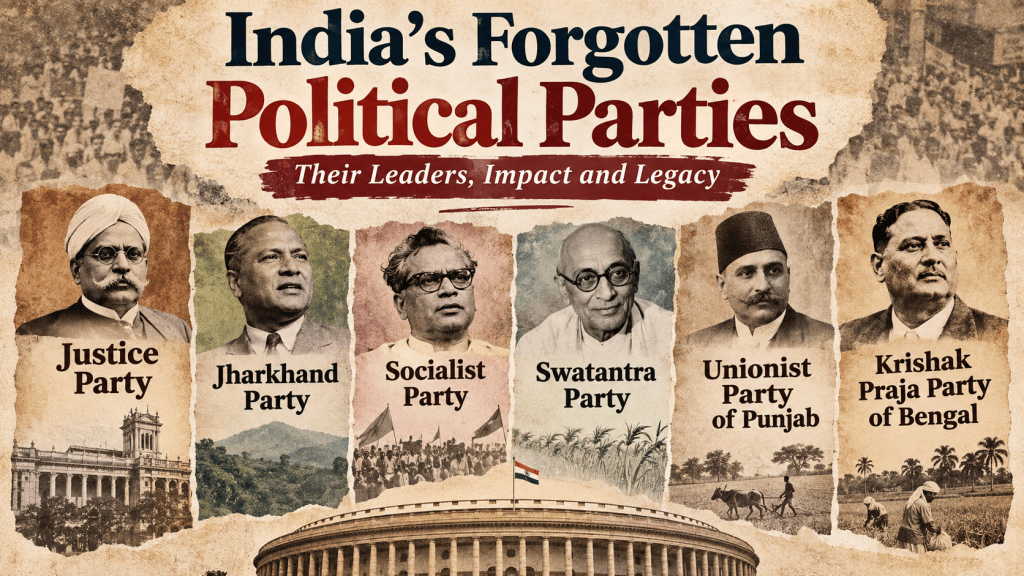
The history of these parties also tells us something important about the making of modern India. Long before today’s familiar political formations took shape, political organisations were already debating questions of caste, social justice, federalism, economic freedom, agrarian rights, tribal identity and the relationship between the state and its citizens. Six such parties stand out for the political traditions they helped establish: the Justice Party in the Madras Presidency, the Jharkhand Party in eastern India, the Socialist Party, the Swatantra Party, the Unionist Party of Punjab and the Krishak Praja Party of Bengal.
Justice Party: The Beginning of the Dravidian Political Tradition
The story of the Justice Party begins in Madras in 1916, when the South Indian Liberal Federation was established by leaders including C. Natesa Mudaliar, P. Theagaraya Chetty and T. M. Nair. It soon became popularly known as the Justice Party. Its politics emerged from opposition to the dominance of Brahmins in administration, education and public institutions under colonial rule. The party demanded greater representation for non-Brahmin communities and argued that government institutions should reflect the social composition of the wider population.
The Justice Party came to power in the Madras Presidency after the elections of 1920, becoming one of the earliest Indian political organisations to form a government through the limited electoral system introduced under the Montagu-Chelmsford reforms. Its governments introduced measures associated with communal representation in public employment and education, while also supporting changes in education and social policy. The Communal Government Order of 1921 became one of its most important and controversial measures because it attempted to distribute government opportunities among different communities rather than allowing recruitment to be dominated by a small social group. The Madras Legislative Council also removed sex as a disqualification for voting in 1921, although this was far from universal adult suffrage.
The party’s influence declined considerably after the rise of the Indian National Congress in provincial politics. Its defeat in the 1937 elections marked a major turning point. Yet the political current it represented did not disappear. In 1944, E. V. Ramasamy, popularly known as Periyar, transformed the Justice Party into the Dravidar Kazhagam. Periyar rejected electoral politics and concentrated on the broader social movement against caste hierarchy, Brahminical dominance and social inequality. A few years later, C. N. Annadurai broke away and founded the Dravida Munnetra Kazhagam in 1949. The DMK and, subsequently, other Dravidian political formations carried forward parts of the social justice, linguistic and regional political tradition that had developed through the Justice Party and the movements that followed it. The Justice Party therefore disappeared as an organisation, but its political vocabulary survived.
Jharkhand Party: Jaipal Singh and the Long Road to Statehood
A very different kind of regional politics developed in the eastern and central tribal areas around Jaipal Singh Munda. A celebrated hockey player who captained the Indian team at the 1928 Amsterdam Olympics, Jaipal Singh became one of the most important political voices for the tribal communities of the Chotanagpur and Santhal regions. He first led the Adivasi Mahasabha and later transformed it into the Jharkhand Party around the beginning of the 1950s.
The demand was larger than an ordinary electoral programme. Jaipal Singh argued that the tribal population of the region needed political recognition and a state of its own in which its cultural identity, land rights and interests could receive greater protection. In the first general elections of 1951-52, the Jharkhand Party won 33 seats in the Bihar Legislative Assembly, establishing itself as a significant regional force. It performed strongly again in the 1957 elections.
The States Reorganisation Commission, however, did not accept the demand for a separate Jharkhand state in 1955. The movement consequently entered a difficult phase. In 1963, Jaipal Singh merged the Jharkhand Party with the Congress, a decision that weakened the party as an independent political force. But the idea of Jharkhand did not disappear with the merger. New organisations and movements later took up the cause, most prominently the Jharkhand Mukti Morcha. Other regional formations, including the All Jharkhand Students Union, also became important in the politics surrounding statehood. When Jharkhand was finally created as a separate state on 15 November 2000, the achievement was the culmination of a much longer political movement in which Jaipal Singh and the Jharkhand Party had played an early and important role.
Socialist Party: A Political Tradition That Refused to Disappear
If the Justice Party represented a struggle for social and political representation and the Jharkhand Party represented regional and tribal aspirations, the Socialist Party represented another major strand of Indian political thought. Its roots lay in the Congress Socialist Party, established within the Indian National Congress in 1934. Among those associated with the socialist movement were Acharya Narendra Deva, Jayaprakash Narayan, Ram Manohar Lohia, Achyut Patwardhan, Asoka Mehta and Yusuf Meherally.
These leaders were influenced by socialist ideas but were also deeply engaged with India’s freedom struggle. They wanted political independence to be accompanied by economic and social transformation. After independence, the socialist group separated from the Congress and the Socialist Party emerged as an independent political organisation in 1948. Its history thereafter became closely tied to the tendency of socialist politics in India to divide, reunite and divide again.
Another important organisation, the Kisan Mazdoor Praja Party, was formed in 1951 under the leadership of J. B. Kripalani and others. In 1952, it merged with the Socialist Party to create the Praja Socialist Party. The new party attempted to build a broad democratic socialist alternative to the Congress, but internal disagreements and ideological differences continued to affect its fortunes.
The socialist tradition nevertheless proved far more durable than any single organisation. Leaders such as Lohia and Jayaprakash Narayan influenced generations of political activists, while socialist politics later contributed to the emergence of the Janata tradition and several regional parties. The Samajwadi Party, founded by Mulayam Singh Yadav in 1992, is one of the prominent later political formations associated with this broader socialist inheritance, although it should not be described as the direct organisational successor of the old Socialist Party. The old party disappeared, but the ideas of social justice, democratic socialism, backward-class representation and opposition to political centralisation continued to find new political homes.
Swatantra Party: The Liberal Voice Against State Control
The Swatantra Party emerged from a completely different ideological direction. Founded in 1959 by C. Rajagopalachari, Minoo Masani, N. G. Ranga and others, it was a reaction against the increasingly dominant economic philosophy of the Congress under Jawaharlal Nehru. The party opposed excessive state control of the economy, extensive economic planning and the expansion of the public sector at the expense of private enterprise.
It is sometimes described loosely as a centrist party, but its economic position is better understood as liberal and economically right-of-centre for its time. Swatantra defended private property, individual economic freedom, agricultural interests and a reduction in bureaucratic controls. In an India where socialist planning dominated the political mainstream, these positions made the party unusual.
Its electoral rise was remarkable. In the 1962 general election, its first major national electoral contest, the party won 18 seats in the Lok Sabha. Its strongest performance came in 1967, when it won 44 Lok Sabha seats and emerged as the largest opposition party in Parliament. Its influence was particularly visible in states such as Rajasthan, Gujarat and parts of southern India. But the party struggled to maintain its momentum as Indian politics became increasingly polarised and its organisational base remained limited.
Swatantra won only eight Lok Sabha seats in the 1971 general election. In 1974, it merged into the Bharatiya Lok Dal. The party itself vanished, but the debate it had raised about state control, economic freedom, taxation, private enterprise and the limits of centralised planning acquired renewed relevance in later decades. Some of the economic arguments associated with Swatantra would sound far less unusual after India’s economic reforms of 1991, although it would be misleading to portray the party simply as a blueprint for those reforms.
Unionist Party of Punjab: An Agrarian Alternative in Undivided Punjab
Punjab’s political history produced another unusual experiment in the form of the Unionist Party. Organised in 1923 under the leadership of Sir Fazl-i-Husain, the Unionists built their political strength around the agrarian interests of Punjab. Sir Chhotu Ram, Sir Sikandar Hayat Khan and later Sir Khizar Hayat Tiwana became some of its most prominent leaders.
What distinguished the Unionists was their attempt to build a political coalition that crossed religious boundaries. Muslims, Hindus and Sikhs were all represented within the party, although its political base was closely connected to the rural and landed interests of Punjab. Its politics was therefore not a modern egalitarian mass movement, but it offered a significant alternative to communal mobilisation by emphasising agrarian interests and provincial politics.
The Unionists became a major force in the Punjab Legislative Council and formed the provincial government after the 1937 elections. Sir Sikandar Hayat Khan served as Premier until his death in 1942, after which Khizar Hayat Tiwana became the leading figure in the provincial government. The party’s influence, however, was increasingly challenged by the Muslim League, the Congress and the growing communal tensions of the 1940s.
The Unionist coalition ultimately could not survive the political upheaval surrounding Partition. Khizar Hayat Tiwana resigned in March 1947, and the political world in which the Unionist Party had operated was rapidly disappearing. Partition and the creation of Pakistan effectively brought the party’s history in undivided Punjab to an end. Its significance lies in the fact that it represented an important, though ultimately unsuccessful, attempt to build provincial politics around agrarian interests rather than allowing communal identity to become the sole basis of political mobilisation.
Krishak Praja Party of Bengal: The Peasant Voice That Faded
Bengal produced another powerful experiment in peasant politics through the Krishak Praja Party. Founded in 1936 under the leadership of A. K. Fazlul Huq, the party emerged from the political movement around the interests of peasants and tenants, particularly those burdened by the zamindari system and rural indebtedness.
Fazlul Huq was one of the most colourful political figures of pre-Partition Bengal. His political appeal was rooted in the countryside, and the Krishak Praja Party promised measures aimed at improving the position of tenants and cultivators. It supported the abolition of zamindari, reduction of rents, protection for tenants, relief from rural debt and better access to agricultural credit and irrigation. It also advocated free primary education. Its politics gave voice to sections of Bengal’s rural population who often felt neglected by elite-dominated political organisations.
The party performed strongly in the 1937 Bengal elections, winning 36 of the 250 seats in the provincial legislature. Fazlul Huq subsequently formed a government with support from the Muslim League, although the relationship between the two organisations remained complicated. Over time, internal divisions, political realignments and the growing strength of the Muslim League weakened the Krishak Praja Party. By the 1946 elections, it won only four seats, a dramatic decline from its earlier influence.
Fazlul Huq continued to play an important role in Bengal’s politics and later associated himself with another peasant-oriented organisation, the Krishak Sramik Party. But the original Krishak Praja Party had effectively lost its political importance. Its legacy remained connected to the question it had placed at the centre of Bengal’s politics: whether the interests of ordinary cultivators and tenants could be represented effectively in a political system dominated by larger national and communal forces.
When the Parties Disappeared, Their Ideas Survived
These six parties belonged to different regions and ideological traditions, but they shared one common fate. None remains a major independent political force today. The Justice Party gave way to a broader Dravidian movement. The Jharkhand Party’s original organisation faded after its merger with the Congress, even as the demand for Jharkhand continued for decades. The Socialist Party disappeared amid repeated mergers and splits, while its political ideas spread across several later formations. Swatantra’s liberal economic politics eventually became part of a much wider debate about the role of the state and the market. The Unionists were swept away by Partition, and the Krishak Praja Party was overtaken by the rapidly changing politics of Bengal.
Their disappearance, however, should not be confused with irrelevance. Political parties are often temporary institutions, while political ideas can survive much longer. The Justice Party’s emphasis on representation helped shape the politics of social justice in southern India. Jaipal Singh’s Jharkhand Party helped establish the political legitimacy of a separate tribal state. Socialist leaders influenced generations of Indian politicians and movements. Swatantra kept alive a liberal critique of excessive state control at a time when such views were far outside the political mainstream. The Unionists demonstrated the possibilities and limitations of cross-community agrarian politics in Punjab. The Krishak Praja Party brought the problems of peasants and tenants to the centre of Bengal’s provincial politics.
India’s political history is therefore not only the history of parties that won elections and survived. It is also the history of parties that disappeared but left behind ideas that others inherited. Some were defeated by electoral change, some were absorbed through mergers, some were destroyed by Partition, and others simply lost their political moment. Yet their leaders, arguments and movements continued to shape the country in ways that are sometimes easier to see in retrospect than they were at the time.
That is perhaps why these forgotten parties deserve to be remembered. They were not merely footnotes in India’s political history. For a time, each represented a different answer to the question of what the new India should look like. Their organisations may have vanished, but parts of those answers continue to live on in India’s political landscape.
India’s Forgotten Political Parties: Their Leaders, Impact and Legacy


Leave a Reply