India’s freedom struggle was fundamentally a movement led and sustained by Indians. Millions of Indians, including men and women, farmers, workers, students and political leaders, participated in the long struggle against British colonial rule. Yet the movement also attracted important supporters from outside India.
These foreign nationals came from Britain, the United States, Ireland and other countries. Some travelled to India and worked alongside Indian nationalists. Others never made India their permanent home but supported the cause from their own countries through journalism, political activism, public meetings, fundraising and international campaigns.
Their stories reveal an important international dimension of India’s freedom struggle. The demand for Indian independence was increasingly understood not simply as an Indian issue, but as part of the wider struggle against imperialism, racial discrimination and political oppression.
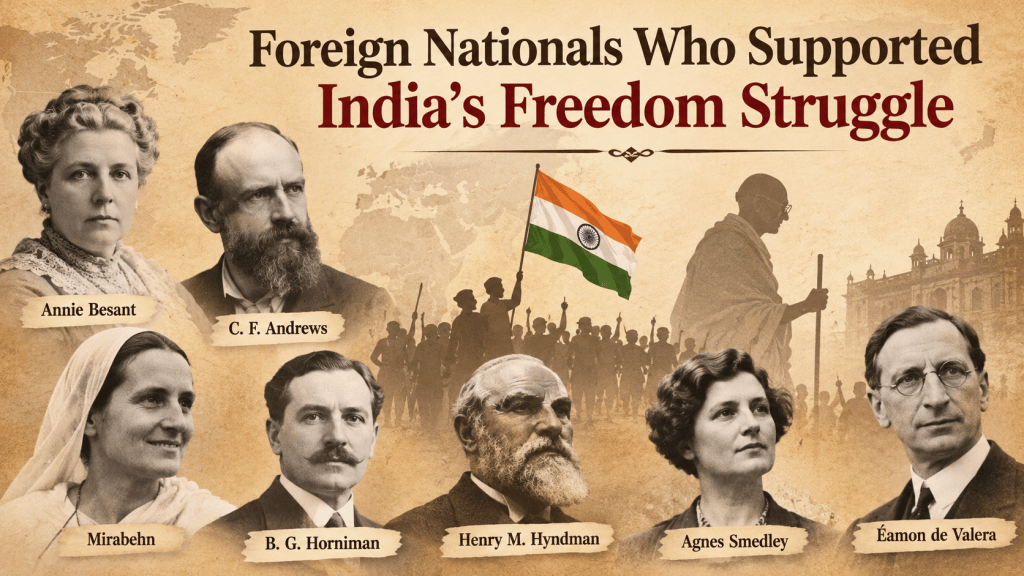
Annie Besant: A British Advocate of Home Rule
Among the most prominent foreign supporters of Indian self government was Annie Besant, born in London to an Irish family.
Besant came to India in the late nineteenth century and gradually became deeply involved in Indian political and social life. She argued that Indians should have the right to govern themselves and became one of the leading voices of the Home Rule movement.
In 1916, she established the Home Rule League and campaigned for self government through speeches, newspapers and political organisation. Her activities helped bring the demand for Home Rule to a much wider audience.
In 1917, Besant became the first woman president of the Indian National Congress. Her career demonstrated that opposition to colonial rule could also come from people born within the British Isles.
C. F. Andrews: A British Friend of Gandhi
Charles Freer Andrews, an English missionary and educator, became one of the most respected British friends of the Indian nationalist movement.
Andrews came to India as a missionary and teacher but became increasingly disturbed by racial discrimination and colonial injustice. He developed close relationships with Mahatma Gandhi, Rabindranath Tagore and other Indian leaders.
He worked for the rights of Indians both in India and overseas, particularly Indian indentured labourers. His efforts against racial discrimination made him an important bridge between Indian nationalists and sympathetic people in Britain and elsewhere.
Andrews did not simply criticise individual colonial policies. He came to believe that the dignity and political rights of Indians had to be respected. His friendship with Gandhi became an enduring example of international solidarity.
Mirabehn: An Englishwoman Who Became Gandhi’s Disciple
Madeleine Slade, popularly known as Mirabehn, was born in Britain and became deeply inspired by Gandhi’s philosophy.
After reading about Gandhi and his ideas of non violence, she travelled to India in 1925 and joined his ashram. She adopted a simple lifestyle and devoted herself to Gandhi’s constructive programmes and the national movement.
Mirabehn participated in the freedom struggle and was imprisoned by the colonial authorities. She also worked on rural development, agriculture, animal welfare and environmental issues.
Her life is particularly remarkable because she voluntarily abandoned a privileged background in Britain to dedicate herself to the ideals associated with India’s struggle for freedom.
B. G. Horniman: A British Journalist Who Exposed Colonial Repression
Benjamin Guy Horniman, a British journalist, used the power of the press to support Indian nationalism.
Horniman edited the Bombay Chronicle and became an outspoken critic of British colonial policies. His reporting during the period of the Rowlatt Act and the Jallianwala Bagh massacre of 1919 challenged the official British narrative.
He helped circulate information about the massacre and was subsequently deported from India by the colonial government. His reporting also reached audiences outside India, helping draw international attention to British repression.
Horniman’s contribution is significant because journalism allowed the Indian cause to reach readers who might otherwise have known little about colonial violence.
Henry M. Hyndman: Supporting India from Britain
One of the important foreign supporters who worked within his own country was Henry Mayers Hyndman, an English socialist and political activist.
Unlike foreign supporters who travelled to India, Hyndman spent much of his political career in Britain campaigning against imperialism. He developed connections with Indian nationalist figures such as Dadabhai Naoroji and became a vocal supporter of Indian nationalism and independence.
Hyndman used his political writings, speeches and socialist networks to criticise British rule in India. His 1907 work The Unrest in India expressed support for the Indian people’s resistance to British colonial rule.
His importance lies particularly in the fact that he challenged imperialism from within Britain itself, the centre of the British Empire.
Agnes Smedley: An American Campaigner for India’s Freedom
Agnes Smedley, an American writer, journalist and activist, played an important role in supporting India’s cause in the United States.
Smedley encountered Indian nationalists in America and became increasingly involved in the Indian independence movement. She worked with figures including Lala Lajpat Rai, M. N. Roy, Tarak Nath Das and Virendranath Chattopadhyay.
In 1919, she helped establish the Friends of Freedom for India in New York. The organisation sought to present the case for Indian independence to American public opinion and to defend Indian political refugees.
Smedley helped connect Indian revolutionaries and activists with American journalists, labour organisations, intellectuals and political campaigners. She also used her position as an American citizen to raise awareness about the treatment of Indian nationalists in the United States.
Her work demonstrates that the Indian freedom struggle had developed an international network far beyond India’s borders.
American Supporters Around Agnes Smedley
Smedley was not working alone. A number of Americans became involved in campaigns supporting Indian nationalism.
Among them were Frank Walsh, Robert Morss Lovett and Gilbert Roe, who joined with Smedley and other American activists in advocating the Indian cause in the United States.
The Friends of Freedom for India organised public campaigns and sought to persuade Americans that India’s demand for independence deserved international support.
This was important because Indian activists in America faced surveillance, restrictions and the possibility of deportation. American supporters could use their own citizenship and political connections to amplify the Indian cause.
Éamon de Valera: Irish Support for India
The connection between the Indian and Irish struggles against British rule was particularly significant.
Éamon de Valera, an Irish revolutionary and political leader, also expressed solidarity with India’s freedom struggle. In 1920, he addressed an India Freedom Dinner in New York organised by the Friends of Freedom for India.
De Valera connected the Irish struggle for independence with India’s struggle against British imperialism. His participation helped bring together supporters of Irish independence, Indian independence and wider anti colonial movements in the United States.
The connection between Ireland and India was powerful because both peoples had experienced British imperial rule and had developed movements demanding national self determination.
Why Did Foreigners Support India?
The foreign supporters of India’s freedom struggle were motivated by different ideas.
Some opposed imperialism and believed that no nation had the right to rule another without its consent. Others were motivated by socialism, Christianity, liberalism, anti racism or humanitarian principles.
For some, personal friendships with Indian nationalists transformed their understanding of colonialism. Others encountered India’s cause through journalism, political meetings or international movements against imperialism.
In the United States, activists such as Agnes Smedley tried to connect India’s struggle with American traditions of liberty and the country’s own history of revolution. The Friends of Freedom for India appealed to American public opinion in this way.
India’s Freedom Struggle as an International Cause
By the early twentieth century, India’s independence movement had become connected to political movements across the world.
Indian nationalists travelled to Britain, Europe, North America and other parts of Asia. They established organisations, published newspapers and pamphlets, addressed public meetings and built relationships with foreign political activists.
Foreign supporters played a useful role in these international networks. They could speak to audiences in their own countries, challenge imperial propaganda and sometimes provide political, legal or financial assistance.
The work of Agnes Smedley in the United States is a particularly clear example. Her organisation reached thousands of individuals, organisations and newspapers and helped connect American activism with Indian anti colonial politics.
Conclusion
India’s independence was won primarily through the courage, sacrifice and sustained struggle of Indians themselves. Foreign supporters did not lead the movement, but some made meaningful contributions to the wider campaign for freedom.
People such as Annie Besant, C. F. Andrews, Mirabehn, B. G. Horniman, Henry M. Hyndman and Agnes Smedley, along with other British, American and Irish sympathisers, supported India’s cause in different ways.
Some came to India and worked alongside Indian nationalists. Others remained in Britain, the United States or other countries and campaigned for India’s freedom from there.
Their stories reveal that the Indian freedom struggle was not isolated from the rest of the world. It inspired an international network of people who believed that colonial domination, racial discrimination and political oppression should come to an end.
Ultimately, the history of India’s independence is also a story of international solidarity. People from different nations and cultures recognised India’s right to determine its own future and contributed, in their own ways, to the larger cause of freedom.
Foreign Nationals Who Supported India’s Freedom Struggle


Leave a Reply