Everyday food carries extraordinary stories. Some travelled along the Silk Route, others arrived with traders and seafarers, while many came with explorers and settlers. Their journeys began centuries ago, but their memories survive in the names we continue to use in our kitchens.
We eat food every day, rarely pausing to think about where it originated, how it reached our kitchens or why we call it by a particular name.
Look a little closer at the Indian kitchen, however, and you will discover something fascinating. Hidden in the names of our fruits, vegetables, spices and beverages are memories of ancient trade routes, distant kingdoms, foreign lands and centuries of cultural exchange.
Our everyday vocabulary is, in many ways, a historical map of the world.
When China came into our sugar bowl
Sugar is perhaps one of the most indispensable ingredients in our daily diet. We add it to milk, tea, coffee, sweets, desserts and countless other preparations.
Yet, in Hindi, we do not call it sugar. We call it Cheeni (चीनी), a name associated with China.
Indian traders once brought large quantities of sugar from China through the Silk Route. The name Cheeni continues to preserve the memory of these historical commercial connections.
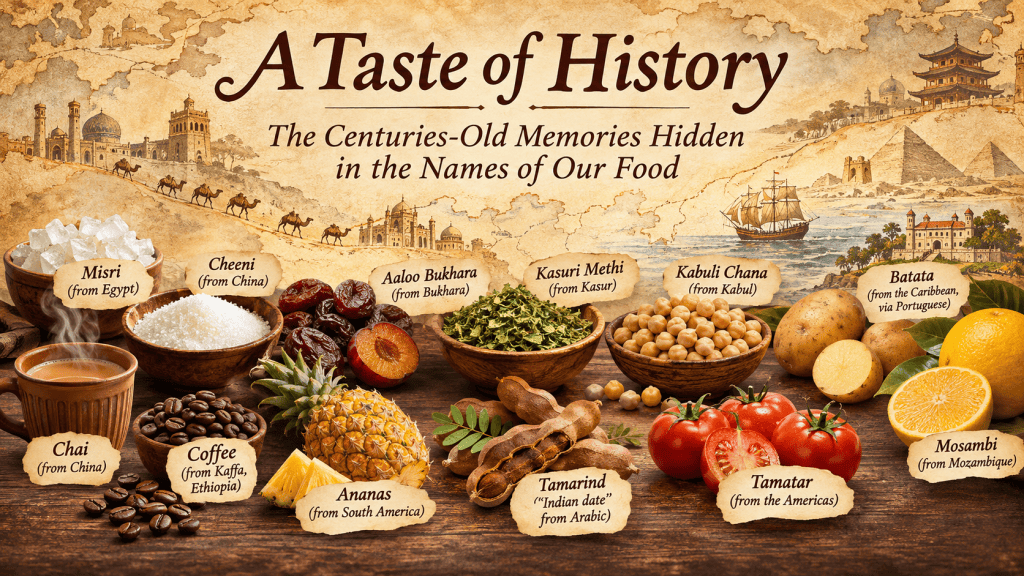
Another familiar word is Misri (मिश्री), the crystalline form of sugar used in Indian households, religious offerings and traditional preparations. Its name is associated with Misr, the Arabic name for Egypt. Thus, even the sweeteners in our kitchens evoke distant civilisations.
Aloo Bukhara: A fruit that remembers a trading city
Consider the humble plum.
In Hindi, it is called Aaloo Bukhara (आलूबुखारा). The name takes us to Bukhara, the historic city in present-day Uzbekistan.
Bukhara was an important centre of commerce and culture along the Silk Route. Traders, travellers and caravans connected Central Asia with Persia, India and China.
The name Aaloo Bukhara preserves this geographical association. It is almost as if the fruit carries the name of an ancient trading destination in its very identity.
Kasuri Methi: A fragrance from across the border
Another familiar ingredient in Indian cooking is Kasuri Methi.
The name comes from Kasur, a historic town in present-day Pakistan. Dried fenugreek leaves are widely used in North Indian cooking. A small quantity added to butter chicken, paneer or dal can transform the aroma of an entire dish.
The word Kasuri reminds us of a time when the regions on either side of today’s international border were connected through trade, agriculture, food traditions and everyday movement.
Kabuli Chana: From Kabul to the Indian kitchen
Chickpeas are among the most important sources of plant protein in Indian diets.
They feature prominently in school mid-day meals, hostel messes, roadside eateries and family kitchens. Chole, chana masala and chana chaat are household favourites.
Yet one variety is called Kabuli Chana.
The name refers to Kabul, the capital of Afghanistan. The term reflects the historical association of this larger, lighter-coloured chickpea with Afghanistan and the north-western trade networks connecting the Indian subcontinent with Central Asia.
Today, Kabuli Chana is thoroughly at home in India, having become an integral part of our everyday cuisine.
Batata: A Portuguese memory in Marathi
In Maharashtra, potatoes are commonly called Batata.
The word has an interesting overseas history. It is related to batata, a Caribbean term for sweet potato, adopted into European languages by Spanish and Portuguese explorers.
The potato itself originated in the Andes of South America. Its arrival in India is associated with European maritime trade and colonial-era exchanges.
The Portuguese established settlements in Goa, and their influence travelled beyond the coastal settlements into neighbouring regions and languages.
The word Batata is a small linguistic reminder of this exchange. Today, Batata Vada, Batata Poha and Batata Bhaji are unmistakably part of Maharashtrian food culture.
Mosambi: A sweet reminder of Mozambique
The sweet lime is popularly known in India as Mosambi.
Its name is associated with Mozambique, the country on Africa’s south-eastern coast.
Whether enjoyed as a whole fruit or in the form of freshly squeezed juice, Mosambi has become a familiar part of Indian summers. Yet its name takes us across the Indian Ocean to the eastern coast of Africa.
Our fruit vendors still announce Mosambi juice without necessarily realising that the name carries an echo of another continent.
Coffee and the mystery of Kaffa
Coffee is another beverage with a remarkable geographical history.
Coffee plants originated in Ethiopia, and the Kaffa region in south-western Ethiopia is frequently associated with the history of coffee.
Coffee travelled from Ethiopia to Yemen and then across the Arab world, eventually reaching Europe and the rest of the world.
India, too, developed its own rich coffee culture, particularly in the southern states. Today, filter coffee is as much a part of South Indian identity as a steaming cup of chai is of North India.
Chai: A Chinese word in an Indian cup
Few things are more Indian than a steaming cup of chai.
Yet the word Chai has travelled a very long way.
It comes from the Chinese word Cha (茶), used in Mandarin and several other Chinese languages.
The words Chai and Cha travelled largely through overland trade routes, including the Silk Route. The words Tea, Thé and Thee, on the other hand, travelled largely through maritime trade, particularly from Chinese coastal trading regions.
Thus, even the name of our everyday cup of tea tells the story of ancient international commerce.
Ananas: A journey from South America
The word Ananas, used for pineapple in many Indian languages, comes from the Tupi word nanas, used by Indigenous people of South America.
Portuguese traders helped carry the word across continents. The fruit eventually found its way into Indian markets and kitchens, becoming a favourite in fruit salads, desserts, juices and traditional preparations.
A simple word like Ananas connects an Indian fruit basket to the tropical landscapes of South America.
Tamarind: The Indian date
The English word Tamarind comes through the Arabic expression tamr hindi, meaning literally “date of India”.
The comparison was made because of the fruit’s pod-like appearance and pulp.
It is remarkable that the name of a fruit so familiar in Indian chutneys, sambhar and curries preserves an old Arabic description of India.
Tamarind is another reminder that Indian food ingredients travelled across borders, carrying their names and associations with them.
Tamatar: A word from the Americas
The word Tomato ultimately comes from the Nahuatl word tomatl, spoken by Indigenous people of Mexico.
It travelled into European languages through Spanish and eventually entered Indian vocabulary as Tamatar.
Today, it is difficult to imagine Indian cooking without tomatoes. From our everyday dal and sabzi to elaborate gravies, the tomato has become indispensable.
Yet its name reminds us that this familiar ingredient has roots thousands of kilometres away in the Americas.
Food is the oldest record of globalisation
Long before aeroplanes, refrigerated containers and international supermarkets, people were trading food across continents.
Caravans travelled along the Silk Route. Ships crossed the Arabian Sea and the Indian Ocean. Merchants carried spices, fruits, grains and seeds. Explorers brought unfamiliar crops to new lands. Migrants carried recipes, tastes and food habits with them.
Every such journey left behind something.
Sometimes it was a new ingredient. Sometimes it was a new recipe. And sometimes it was simply a word.
The Indian kitchen is therefore much more than a place where food is prepared. It is a living museum of human migration, commerce and cultural exchange.
The next time you sprinkle Kasuri Methi into a curry, eat Aaloo Bukhara, prepare Kabuli Chana, enjoy a Batata Vada, drink Mosambi juice or add Cheeni and Misri to your daily life, pause for a moment.
You may be experiencing something that travelled thousands of kilometres and crossed several civilisations before becoming part of your everyday life.
Our food remembers what we have forgotten. Every bite has a history, and every name has a journey.
A Taste of History: The Centuries-Old Memories Hidden in the Names of Our Food


Leave a Reply