Generations Are Defined by Experiences, Not Birth Dates
Imagine two people born just seconds apart. One is born on 31 December 1996, and the other on 1 January 1997. According to some commonly used definitions, the first belongs to the Millennial generation, while the second belongs to Generation Z. Does a difference of just a few seconds really make them members of two different generations? To me, this sounds rather ridiculous. Both individuals would grow up in almost the same social environment, experience the same major historical events, and encounter similar technological changes at roughly the same stages of life. Their childhood memories, educational experiences, and cultural influences would probably have far more in common than the labels assigned to them suggest.
This is the fundamental problem with rigid generational divisions. We use birth years to classify people, even though generations are shaped by shared experiences. I believe generations are better understood through the historical events, technological transformations, and social changes that people experience during their formative years. Birth years can help us identify broad patterns, but they should not be treated as hard boundaries. Rather than defining an entire generation through a fixed range of birth years, we should identify the core group of people who experienced a particular event at a formative age while acknowledging that its influence extends beyond that group.
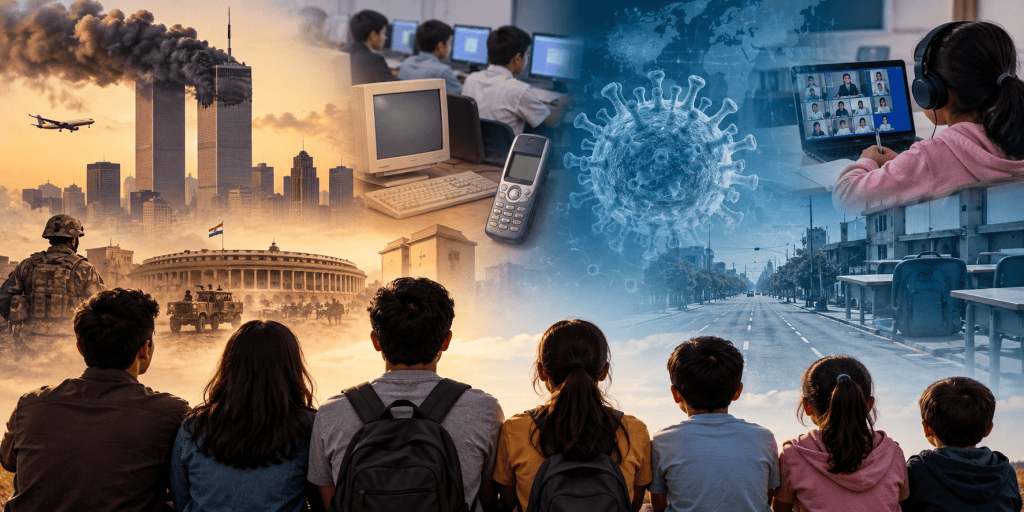
Consider the COVID-19 pandemic, one of the most disruptive global events of the twenty-first century. It affected education, employment, family life, social interaction, and public health across the world. For millions of schoolchildren, education suddenly moved from classrooms to computer screens. Schools closed, examinations were postponed or cancelled, friendships shifted to digital platforms, and ordinary childhood activities were interrupted by lockdowns. However, the impact of the pandemic was not the same for everyone. A young child experienced school closures differently from a teenager preparing for examinations or a university student approaching graduation. The event was the same, but the stage of life at which it occurred shaped the experience.
Imagine a child who was six years old when the pandemic began in 2020. This child was old enough to have started school and potentially remember lockdowns, school closures, and the transition to online education. Now consider a sixteen-year-old teenager who was also attending school but was facing a very different set of challenges involving examinations, friendships, academic decisions, and plans for the future. Despite their differences in age, both experienced the pandemic during their school years. Using 2020 as a reference point, children born approximately between 2004 and 2014 were between six and sixteen years old when the pandemic began. I would therefore consider 2004–2014 the core birth-year range for the generation that experienced the COVID-19 pandemic during its school years.
This is not a rigid definition, nor does it mean that everyone born within this range had an identical experience. A person born in 2002 might have experienced the pandemic during the final years of school, while someone born in 2016 might remember lockdowns, disrupted early education, or the consequences of social isolation. Experiences also varied considerably across countries, communities, and education systems. The purpose of identifying 2004–2014 as a core range is simply to highlight a group whose formative educational experiences were particularly shaped by the pandemic. People born just outside this range may share many of the same experiences, and there is no reason to exclude them from the broader discussion.
Another important historical reference point is 11 September 2001, when terrorist attacks in the United States changed the international political landscape. The attacks were followed by the war in Afghanistan, the Iraq War, heightened security measures, and a prolonged period in which terrorism and international security became central concerns in global affairs. India also witnessed the terrorist attack on its Parliament in December 2001, intensifying tensions with Pakistan and shaping the country’s security discourse. These events were not isolated incidents in the news; they helped define the geopolitical environment in which an entire cohort of children and teenagers grew up.
The early 2000s were also a period of remarkable technological transformation. Mobile phones were becoming increasingly common, internet access was expanding, and personal computers were gradually becoming more accessible. Computer laboratories were appearing in schools, introducing many students to a new digital world. For some, the internet was something they first encountered at school or in a cybercafé before gaining access at home. Mobile phones gradually transformed communication, while computers began changing how students learned, worked, and accessed information. For children and teenagers growing up during this period, these changes were not merely technological developments; they were part of their everyday transition from childhood to adulthood.
Consider a six-year-old child in 2001 who watched television coverage of the attacks with family members, heard adults discussing the consequences, and gradually grew up in a world increasingly shaped by security concerns and digital technology. Now consider a sixteen-year-old teenager in the same year who was more likely to understand the political implications, follow the news independently, and remember the event as a defining moment in contemporary history. Both could have been shaped by the same historical turning point, although their levels of awareness and understanding would have differed. Using 2001 as the reference year, children aged approximately six to sixteen were born between 1985 and 1995. I would therefore identify 1985–1995 as the core birth-year range for the generation that experienced 9/11, its aftermath, and the early-2000s political and technological transition during its school years.
Once again, this is a proposed experience-based framework rather than a definitive generational classification. Someone born in 1983 may have been in school when the attacks occurred and may share many of the same memories. Someone born in 1997 may also have experienced the event during childhood and grown up during the subsequent technological transition. The experience would have varied according to age, location, access to technology, and exposure to news. Nevertheless, the period provides a useful historical anchor for understanding how political events and technological changes shaped the formative years of a particular group of people.
These two examples illustrate why generational boundaries should be flexible and overlapping. The proposed ranges of 1985–1995 and 2004–2014 are not intended to replace every existing generational classification. Instead, they identify core groups through particular historical experiences. A generation shaped by the arrival of the internet need not have precisely the same boundaries as one shaped by a global pandemic. Different historical events affect people at different ages, and the most meaningful age range depends on the experience being studied. A war, an economic crisis, a technological revolution, or a pandemic may each create a distinct shared experience that cuts across conventional generational labels.
This is particularly important because childhood and adolescence are formative periods. Events experienced during these years can influence how people understand the world, build relationships, develop habits, and imagine their futures. A pandemic experienced during primary school may shape someone’s early understanding of health, social interaction, and education, while the same pandemic experienced during adolescence may affect academic choices, friendships, and the transition to adulthood. Similarly, growing up when computers are first entering schools is different from growing up in a world where smartphones, social media, and constant internet access are already commonplace. Historical events provide the context, but a person’s age and circumstances help determine how that context becomes part of their life.
I am not arguing that generational labels should disappear. They can be useful for understanding broad demographic and cultural patterns. What I oppose is treating their boundaries as rigid divisions between people whose lives may be remarkably similar. Someone born on 31 December 1996 is not fundamentally different from someone born on 1 January 1997 simply because one falls on one side of a calendar boundary and the other falls on the opposite side. Their experiences, surroundings, and personal histories matter far more than that arbitrary distinction. Birth dates help us locate people in time, but shared experiences help us understand what that time meant to them.
I would love to hear your views on this idea. Do you agree that generations should be defined primarily by shared historical experiences rather than rigid birth-year ranges? Are the proposed core ranges of 1985–1995 for the generation shaped by 9/11 and the early-2000s transition, and 2004–2014 for the generation that experienced COVID-19 during school years, reasonable starting points? More importantly, what other historical events, political developments, cultural shifts, or technological breakthroughs do you think have played a defining role in shaping particular generations? Share your thoughts and experiences in the comments. Perhaps, by looking at history through the experiences we share, we can develop a more meaningful understanding of what it really means to belong to a generation.
A Critique of popular classification of generations


Leave a Reply