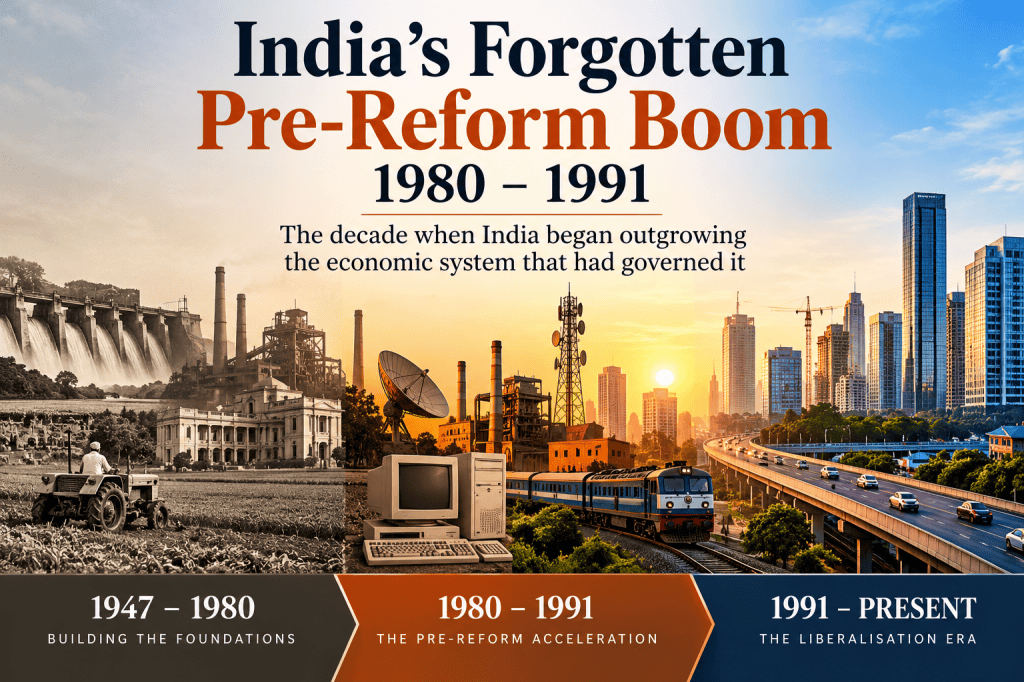
The decade when India began outgrowing the economic system that had governed it
India’s economic history is often presented as a simple two-part story. Before 1991, India followed a state-led, highly regulated development model. After 1991, liberalisation opened the economy to greater competition, private investment and global integration. But this leaves out the crucial decade in between. The 1980s were the forgotten middle of India’s economic transformation.
Between 1980 and 1991, India experienced a significant acceleration in economic growth even though much of the institutional architecture of the Licence Raj remained intact. Industrial licensing had not disappeared. Import restrictions remained extensive. The public sector retained a dominant position. Foreign investment was still tightly controlled. Yet the economy was changing rapidly.
The 1980s were neither simply a continuation of the earlier “Hindu rate of growth” era nor an early version of the post-1991 liberalised economy. They were a transition period in which the foundations created after independence began generating much faster growth as policy gradually shifted towards productivity, modernisation, technology and investment.
1947–1980: Building the Foundations
At independence, India was a poor, predominantly agricultural economy with limited industrial capacity, inadequate infrastructure, low capital availability and a shortage of technical expertise. The state therefore assumed a central role in economic development.
Planning became the organising principle. Import substitution protected domestic industry. Public-sector enterprises were established in strategic sectors. Large investments were made in steel, power, heavy engineering, transport, irrigation, banking, scientific institutions and technical education.
The Green Revolution subsequently transformed agricultural production in important regions and strengthened the rural economic base. This model produced substantial structural change, even though growth remained relatively modest.
India developed industrial capabilities, engineering skills, financial institutions, universities, research institutions, infrastructure and a much larger domestic market.
At the same time, the system became heavily regulated. Industrial expansion often required licences. Imports were tightly controlled. Foreign exchange was scarce. Tariffs were high. Private investment faced extensive restrictions, while the public sector dominated many strategic areas. The result was a paradox. India was accumulating productive capacity while restricting the ability of that capacity to respond efficiently to new opportunities.
By 1980, however, the country had accumulated a much deeper economic base than it possessed in the early years after independence. That foundation would become critical.
1980: The Beginning of the Transition
The year 1980 marks an important economic boundary. The Industrial Policy Statement of 1980 placed greater emphasis on productivity, modernisation, technological improvement and fuller utilisation of existing industrial capacity. This did not abolish the Licence Raj. India remained a highly regulated economy. But the policy emphasis was beginning to change.
The objective was increasingly not simply to create additional capacity through state direction, but to make the capacity already created more productive. That was the first important step in the transition.
1984–1990: Modernisation Gathers Momentum
The change became more visible after 1984, particularly under Rajiv Gandhi. Modernisation and technology received greater attention. Computers, electronics, telecommunications and technological upgrading became increasingly important areas of policy.
The Seventh Five-Year Plan, covering 1985–86 to 1989–90, reflected this changing orientation, with greater emphasis on productivity, modernisation, infrastructure, employment and technological development. India was still not a liberalised economy.
The government did not abandon planning. Industrial licensing remained. Imports were restricted. Foreign investment remained limited. But the system was gradually becoming more flexible.
The 1980s therefore represented an attempt to make the existing economic structure work better rather than immediately replace it. This distinction is essential to understanding the boom.
Why Growth Accelerated
The acceleration of the 1980s came from the interaction of several forces. The first was the productive foundation accumulated during 1947–1980. India now had factories, infrastructure, engineers, technicians, financial institutions and industrial experience.
The second was modernisation. Firms increasingly adopted new technologies and improved productivity.
The third was higher investment, supported by public expenditure and growing private-sector activity.
The fourth was stronger domestic demand, supported by rising agricultural incomes, urbanisation, government expenditure and an expanding consumer market.
The fifth was the growing importance of human capital and technology.
The sixth was the gradual relaxation of some regulatory constraints.
None of these factors alone explains the boom.
Together, however, they created a situation in which the productive capacity built during the earlier decades could generate substantially higher output. The earlier era had built the base. The 1980s began unlocking it. The Numbers Reveal the Break. The growth record illustrates the change.
Real GDP growth was approximately 6.7% in 1980 and 6.0% in 1981. There were weaker years, including 1982, 1984, 1986 and 1987, so the decade was not a perfectly smooth upward movement. But the overall growth trajectory had clearly shifted.
In 1988, real GDP growth reached approximately 9.6% in the annual World Bank series. Growth remained relatively strong at about 5.9% in 1989 and 5.5% in 1990. This was a striking departure from the growth rates associated with the earlier decades.
The significance of the 1980s therefore lies not simply in one exceptional year. It lies in the emergence of an economy capable of sustaining much higher growth than had previously been considered normal.
India had begun experiencing a growth trajectory that increasingly resembled the post-liberalisation era before comprehensive liberalisation had taken place. That is what makes the decade so important. The 1980s Were Not Yet Liberalisation The faster growth of the 1980s should not be mistaken for the reforms of 1991. The Licence Raj remained.
Industrial licensing continued. Imports remained heavily controlled. Tariffs were high. Foreign investment faced strict restrictions. The public sector continued to dominate strategic areas. The explanation for the acceleration was therefore not that India had already become a free-market economy.
Rather, growth was accelerating because the economy had accumulated enough productive capacity for modernisation, investment and partial relaxation of constraints to produce a much larger response. This is the central paradox of the decade.
India could grow faster without completely dismantling the old system because the foundations created under that system had become sufficiently large and mature to respond to changing incentives. But the same experience would eventually reveal the limits of partial reform.
The Cost of the Boom: Fiscal Expansion
The 1980s boom also had a significant macroeconomic weakness. Government expenditure expanded and fiscal deficits became increasingly large.
The central fiscal deficit was around 6.2% of GDP in 1980–81, rising to approximately 7.5% in 1984–85, 8.3% in 1985–86 and about 9.0% in 1986–87. It remained very high towards the end of the decade and reached approximately 8.4% in 1990–91.
Fiscal expansion supported demand and investment and contributed to the acceleration. But persistent borrowing also created vulnerabilities.
The economy was growing faster, but an increasing part of the expansion was being supported by fiscal stimulus rather than by a fully sustainable improvement in productivity and external competitiveness.
The boom was therefore real, but its macroeconomic foundations were becoming increasingly fragile.
The External Constraint
The external sector added another layer of pressure. Faster domestic growth increased demand for imported machinery, energy, technology and intermediate goods. Yet export growth was not sufficient to remove India’s foreign-exchange constraint.
By 1990–91, the current-account deficit was roughly 2.5% of GDP. The 1990–91 Gulf crisis made the situation more difficult. Higher oil prices increased India’s import bill, while the broader external environment deteriorated.
The contradiction became increasingly clear.
India was becoming capable of faster growth, but faster growth required greater access to imports, technology and foreign exchange. The old system had been designed to manage scarcity through controls. The increasingly sophisticated economy was beginning to require greater flexibility and integration.
1991: When Partial Reform Reached Its Limit
By 1991, the fiscal and external pressures had become acute. Foreign-exchange reserves had fallen to dangerously low levels, creating a serious balance-of-payments crisis. The response represented a fundamental change in economic policy.
On 24 July 1991, the government announced the New Industrial Policy. Industrial licensing was abolished for most industries, the role reserved for the public sector was reduced, foreign investment rules were liberalised, and these changes formed part of a broader programme of trade, exchange-rate, financial and fiscal reforms. This was fundamentally different from the changes of the 1980s.
The 1980s had largely sought to make the existing system more productive. The reforms after 1991 increasingly sought to change the rules of the system itself. That is why 1991 remains the major institutional boundary in India’s economic history. But 1991 should not be interpreted as the beginning of India’s growth acceleration. The acceleration had already begun.
Three Economic Eras, Two Major Boundaries
India’s modern economic transformation becomes clearer when divided into three broad phases.
1947–1980: The foundation-building era.
The state created industrial capacity, infrastructure, institutions and human capital within a highly controlled economic framework. Growth remained relatively modest, but the productive foundations of a modern economy were established.
1980–1991: The pre-reform acceleration era.
The basic architecture of the old system remained, but policy increasingly emphasised productivity, modernisation, technology, investment and better utilisation of capacity. Growth accelerated substantially.
1991 onward: The liberalisation era.
Industrial licensing was dismantled across most industries, private enterprise gained greater freedom, foreign investment expanded, trade barriers were reduced and markets assumed a much larger role in resource allocation.
The two boundaries therefore represent different transformations.
1980 was primarily a growth boundary.
1991 was primarily a policy-system boundary.
This explains why the growth numbers of the 1980s could begin to resemble those of the post-1991 period even though India’s economic institutions were still fundamentally different.
Why the 1980s Looked Like a Prelude to Liberalisation
The apparent paradox disappears when growth and liberalisation are separated. Liberalisation can improve competition, investment, technology transfer and resource allocation, but it is not itself the only source of growth.
By 1980, India had already accumulated factories, infrastructure, technical skills, financial institutions, agricultural capacity and a larger domestic market.
The 1980s added modernisation, technological improvement, stronger investment and gradual relaxation of restrictions. The economy responded.
After 1991, the process went much further. Competition increased, trade expanded, foreign investment became more accessible, private enterprise gained greater freedom and India became increasingly integrated into the global economy. Thus, the similar growth performance of the two periods should not obscure their institutional difference.
The 1980s showed what India could achieve by making the old system work better; the post-1991 era showed what could happen when many of the old constraints themselves were removed. The 1980s as the Bridge Between Two Indias. The 1980s were therefore not an anomaly. They were the bridge between two different economic Indias.
The first India was built between independence and 1980: an economy that relied heavily on state intervention to create industrial and institutional capacity.
The second India began emerging in the 1980s: more industrialised, more urban, more technologically capable and increasingly able to generate higher productivity, investment and demand.
The third India emerged after 1991: more competitive, more globally integrated and increasingly driven by private investment, services, trade and market-based allocation.
The transformation was cumulative rather than instantaneous. The reforms of 1991 were enormously important because they accelerated and broadened a process that had already begun.
Conclusion: The 1980s Prepared India for Liberalisation
India’s economic history is often remembered as a story of stagnation before 1991 and liberalisation after 1991. The reality is more interesting.
Between 1980 and 1991, India experienced a genuine pre-reform boom. Growth accelerated, industry modernised, technology gained importance, investment expanded and domestic demand strengthened, all while much of the old regulatory framework remained intact.
The boom was neither a continuation of the old “Hindu rate of growth” nor a fully formed version of post-liberalisation India. It was the bridge between them.
The earlier decades had built the economic foundations. The 1980s began unlocking them. The crisis of 1991 then demonstrated that unlocking those foundations partially was not enough.
Most importantly, the experience of the 1980s demonstrated that the Indian economy had accumulated the productive capacity, entrepreneurial capability, technological base, human capital and domestic demand necessary to respond to greater economic freedom.
The 1991 reforms did not create that readiness from nothing. They acted upon an economy that had already been changing. The 1980s boom was therefore the clearest evidence that the Indian economy was no longer merely surviving within the old system. It was ready to move beyond it, and ready for liberalisation.


Leave a Reply