At thirty-eight, Sahil had begun to suspect that his life had been decided before he was old enough to understand what a decision meant.
He lived in Benaras in a sprawling old house that seemed to have been built less for comfort and more for accommodating people.
His parents lived on the ground floor. His uncle and aunt occupied the rooms above them. Two cousins had married and remained in the house, because that was simply how things were done in their family. There were children everywhere—running through corridors, fighting over toys, demanding sweets, crying for reasons that changed every fifteen minutes.
And then there was his wife.
His wife could find fault with almost anything.
The tea was too cold.
The children were not disciplined.
His mother had interfered.
His uncle had taken too much stock from the shop.
His cousin had not returned money.
Sahil spent his mornings at the family saree business, his afternoons negotiating with suppliers, and his evenings listening to arguments that had somehow continued uninterrupted for twenty years.
The same shop.
The same house.
The same people.
The same problems.
Sometimes, sitting behind the counter while watching customers unfold expensive Banarasi sarees under the white shop lights, Sahil wondered what would have happened if, seventeen years ago, he had simply said yes.
He had been twenty-one then.
A Mumbai-based multinational had offered him a job.
It had seemed like an escape route.
Mumbai.
An apartment.
An office.
A salary.
Independence.
Perhaps, eventually, another country.
He had imagined himself flying across oceans, working in glass buildings, drinking coffee from paper cups while looking at skylines that had nothing to do with Benaras.
He might have married one of his colleagues.
Someone modern.
Someone who understood corporate life.
Someone he had chosen himself.
Perhaps they would have remained DINKs—two incomes, no children, expensive holidays, quiet weekends.
Instead, he had stayed.
His parents had been pleased.
His grandparents had been relieved.
A suitable girl had been found.
They had married.
Children had arrived.
The saree business had become his responsibility.
And seventeen years had passed.
One evening, after a particularly stupid argument about a shipment of silk sarees and an even stupider argument at home about their son’s school project, Sahil walked out of the house.
His wife called after him.
“Where are you going?”
“Just out.”
“For how long?”
“I don’t know.”
“At least tell me—”
But Sahil had already shut the door.
He took the car.
He drove.
He didn’t know where he was going.
For nearly an hour he drove through the outskirts of Benaras, past familiar roads, unfamiliar villages and stretches of darkness where the city slowly disappeared behind him.
Eventually, he found himself at a place he didn’t remember knowing.
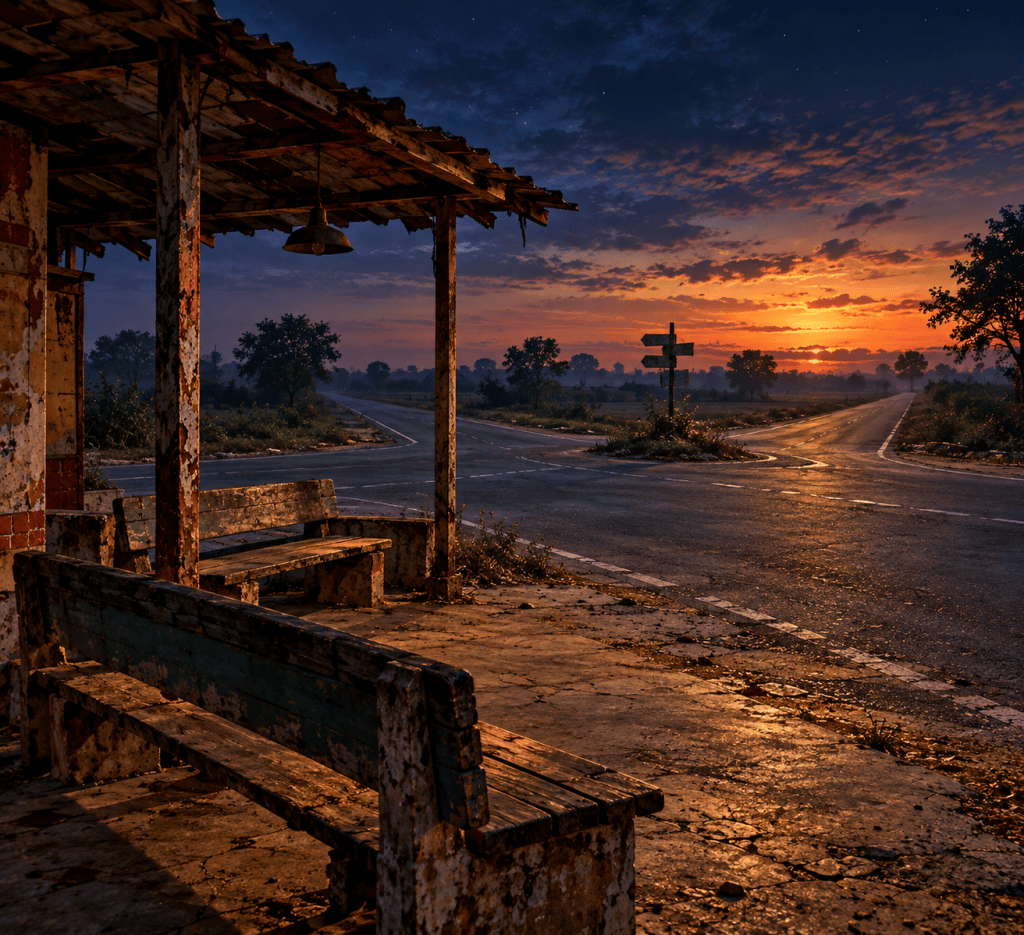
An intersection.
Four roads met there.
There were no signs.
No shops.
No houses nearby.
Only a few trees, an old electric pole and, at the corner, an abandoned dhaba.
The dhaba had probably been closed for years.
Its roof was half collapsed.
The faded signboard could no longer be read.
But the wooden benches were still there.
Sahil parked his car.
He took out a cigarette.
He sat on one of the benches.
For the first time that day, nobody was asking him for anything.
He smoked slowly.
Then he heard a car.
A large black BMW emerged from one of the roads and stopped near the dhaba.
A man in his late thirties stepped out.
Expensive shirt.
Expensive watch.
Expensive shoes.
He looked exhausted.
He glanced at Sahil.
“Mind if I sit?”
Sahil shook his head.
The man sat beside him and lit a cigarette.
For a while, neither spoke.
Then the BMW man sighed.
“Sometimes I wonder what the hell I did with my life.”
Sahil looked at him.
Before he could answer, another vehicle appeared.
An old Alto came from the opposite road.
It stopped.
A man roughly Sahil’s age got out.
His clothes were ordinary.
His face looked older than it should.
He walked toward the bench.
“Can I sit?”
The three men looked at one another.
The BMW man moved aside.
The Alto man sat.
Nobody laughed at the absurdity of it.
Three strangers.
Three cars.
One abandoned dhaba.
One intersection.
And three men who looked as if they had arrived there carrying invisible luggage.
Then came the fourth.
A motorcycle appeared in the distance.
It slowed down at the intersection and stopped.
The rider was barely twenty-two.
He took off his helmet.
He looked around uncertainly.
Then he noticed the three men.
He walked over.
“Is this road going toward Benaras?”
Sahil pointed.
“That one.”
The boy nodded.
But he didn’t leave.
Instead, he sat on the edge of the bench.
The BMW man studied him.
“What’s wrong?”
“Nothing.”
“You look miserable.”
The boy smiled weakly.
“I got a job.”
The three men stared.
“That’s why you’re miserable?” the Alto man asked.
The boy laughed.
“I know it sounds stupid.”
“What job?”
“Bengaluru. MNC. Good salary. Good career. Everything.”
“Then why aren’t you celebrating?” Sahil asked.
The boy looked toward the road.
“My family has a sweet shop.”
The Alto man nodded slowly.
“My father wants me to join.”
“Do you want to?”
“I don’t know.”
Sahil looked at him.
“How old are you?”
“Twenty-two.”
Sahil almost laughed.
“At twenty-two, you shouldn’t know.”
The boy looked at him.
Sahil flicked ash from his cigarette.
“I was twenty-one when I got my chance.”
The other two men listened.
“Same situation,” Sahil continued. “Family business. Parents. Expectations. I got an offer from Mumbai. I could have left.”
“And?”
“I didn’t.”
The boy waited.
Sahil took another drag.
“I stayed.”
“Why?”
“Family.”
The word came out more bitterly than he intended.
He looked down at the cigarette.
“At first, it felt right. Then marriage. Children. Business. Responsibilities. One year became five. Five became ten. Ten became seventeen.”
He laughed quietly.
“Now I sometimes wonder what my life would have looked like.”
The boy asked, “Do you regret it?”
Sahil didn’t answer immediately.
Finally, he said:
“Every now and then.”
The boy looked frightened.
Sahil noticed.
He leaned forward.
“If you want to go, go.”
The Alto man suddenly shook his head.
“No.”
Sahil looked at him.
The man rubbed his hands together.
“I did exactly that.”
The BMW man looked over.
The Alto man continued.
“I had a family business too. I left for Delhi. I thought I would make it big.”
He smiled without humor.
“I didn’t.”
He stared at the road.
“I survived there for ten years. Jobs came and went. Then recession came. I lost my job. By then I was too old to start again and too ashamed to return.”
“What happened to the shop?” the boy asked.
“My grandfather died. The business declined. My father couldn’t manage it alone. There was nobody to take over.”
He paused.
“Eventually my parents sold it.”
The boy looked shocked.
“They sold the family business?”
“They had to.”
The Alto man’s voice became quieter.
“They invested the money and decided to live the rest of their lives from it.”
“And you?”
“I came back.”
He laughed.
“Now I work as an employee in a shop that used to be ours.”
Nobody spoke.
The boy looked at Sahil.
Sahil looked toward the BMW.
“At least he made it,” Sahil said.
The BMW man smiled.
“Yes.”
He took out another cigarette.
“I made it.”
There was no pride in his voice.
“I climbed the ladder. Foreign postings. Promotions. Money. Apartments. Hotels. Business class.”
He looked at the boy.
“I married the woman I wanted.”
Sahil raised an eyebrow.
“The hottest girl in my office,” the man said with a faint smile. “My parents hated the idea. I didn’t care.”
“And?”
“We became DINKs.”
He looked at his BMW.
“Two incomes. No children. We travelled. We bought things. We thought we had figured life out.”
He stopped.
Then he said:
“She divorced me.”
The boy looked away.
The man continued.
“The marriage had been dead for five years.”
“Then why didn’t you leave?” Sahil asked.
“Fear.”
The answer was immediate.
“Fear of admitting that everything I had built wasn’t what I thought it was.”
He took a long drag.
“There were no children. No shared responsibility holding us together. Nothing except habit.”
He looked toward the darkness beyond the intersection.
“So eventually she left.”
“And now?”
“I came back.”
“To your parents?”
“Yes.”
He laughed.
“They have too many grievances.”
He shook his head.
“I thought I would come home and everything would be waiting for me.”
His voice became softer.
“But time doesn’t wait.”
He stared into the darkness.
“My parents are old. My siblings have their own families. People I remember from twenty years ago are not the people who exist now.”
He looked at Sahil.
“I came back looking for my family.”
A pause.
“They exist.”
Another pause.
“But I don’t belong to them anymore.”
Nobody spoke.
The boy looked from one man to another.
Three roads.
Three lives.
Three different answers.
And somehow none of them looked like an answer.
After a while, the Alto man stood.
“I should go.”
The BMW man stood too.
“Me too.”
They walked toward their cars.
The Alto man opened his door.
The BMW man stopped beside his BMW.
Neither looked satisfied.
Neither looked victorious.
They simply drove away.
One road.
Then another.
The boy remained seated.
Sahil finished his cigarette.
The boy looked at him.
“What should I do?”
Sahil looked at the young man.
“What do you want to do?”
“I don’t know.”
“Then nobody can answer that for you.”
The boy looked down.
Sahil stood.
He stretched.
“Go home. Sleep. Talk to your parents. Think about what you’re choosing—and what you’re giving up.”
The boy nodded.
Sahil walked toward his car.
Then the boy called after him.
“Uncle.”
Sahil turned.
The boy looked strangely familiar.
“Why did you stay?”
Sahil froze.
Something moved inside his memory.
The intersection.
The abandoned dhaba.
The bench.
The four roads.
Suddenly, the world seemed to tilt.
He had seen this place before.
Not yesterday.
Not last year.
Seventeen years ago.
He was twenty-one.
He had come here after receiving the Mumbai job offer.
He had driven aimlessly, angry and confused.
And there had been three men.
A young man.
An ordinary man.
A successful man.
He had sat on this same bench.
They had told him their stories.
And then the young man had asked him the same question.
Why did you stay?
Sahil stared at the boy.
He knew what came next.
The boy asked:
“Why did you decide to stay?”
Sahil smiled.
For the first time that evening, genuinely.
“Because I didn’t want to become either of them.”
The boy frowned.
Sahil continued.
“My life isn’t perfect. Maybe it never will be.”
He looked toward the four roads.
“But everyone doesn’t get everything.”
The boy remained silent.
Sahil said:
“Sometimes life isn’t about what you want to gain.”
He paused.
“It’s about what you don’t want to lose.”
The boy thought about it.
Then he nodded.
He put on his helmet.
“Thank you.”
His motorcycle disappeared down one of the roads.
Sahil stood alone.
He wondered whether the boy would take the Bengaluru job.
Perhaps he would.
Perhaps he wouldn’t.
Perhaps he would leave and return ten years later.
Perhaps he would stay and wonder about the road not taken.
There was no perfect answer.
Only consequences.
Sahil was about to get into his car when something caught his eye.
A bicycle.
A young woman had arrived at the intersection.
She stopped.
She looked at the four roads.
She looked left.
Then right.
Then behind her.
She seemed utterly confused.
Sahil watched her from a distance.
He didn’t know her.
But he knew that expression.
He had seen it on his younger sister years ago when her marriage had been arranged.
He had seen it on his wife when she discovered she was pregnant.
He had seen it on his parents when they had to decide what to do with the business after his grandfather’s death.
Perhaps this place wasn’t only his.
Perhaps people came here whenever life placed two roads in front of them and neither one looked entirely right.
Perhaps his sister had come here once.
Perhaps his wife had too.
Perhaps thousands of people had stood at this forgotten intersection without ever knowing that others had stood there before them.
The girl finally chose a road.
She began cycling.
Sahil watched until she disappeared.
Then he got into his car.
He started the engine.
For a moment, he looked toward the road leading away from Benaras.
The road that represented everything he had not become.
Mumbai.
Foreign countries.
Corporate offices.
A different wife.
No children.
Money.
Freedom.
A different version of Sahil.
He wondered about that man sometimes.
But tonight, he didn’t feel angry at him.
Because perhaps that man had his own regrets.
Sahil turned the steering wheel.
He drove toward home.
Toward his parents.
Toward his wife.
Toward his children.
Toward the saree shop.
Toward the arguments.
Toward the laughter.
Toward the chaos.
Toward the imperfect life he had chosen.
He knew he might return to the intersection someday.
Perhaps when another family argument became unbearable.
Perhaps when the business collapsed.
Perhaps when his children left home.
Perhaps when he was sixty and wondered what he had done with his life.
Maybe the four roads would still be waiting.
And perhaps another confused person would be sitting on the old bench.
But Sahil knew something now.
A life was not made meaningful because every choice turned out perfectly.
A life was made by accepting that every choice closes some doors.
And sometimes, when you choose one road, you aren’t choosing everything that road gives you.
You are also choosing everything you are willing to leave behind.
The lights of Benaras appeared in the distance.
Sahil drove toward them.
Home was waiting.
And this time, he didn’t wonder whether he had chosen correctly.
He simply drove on.
The Intersection


Leave a Reply