A dark room.
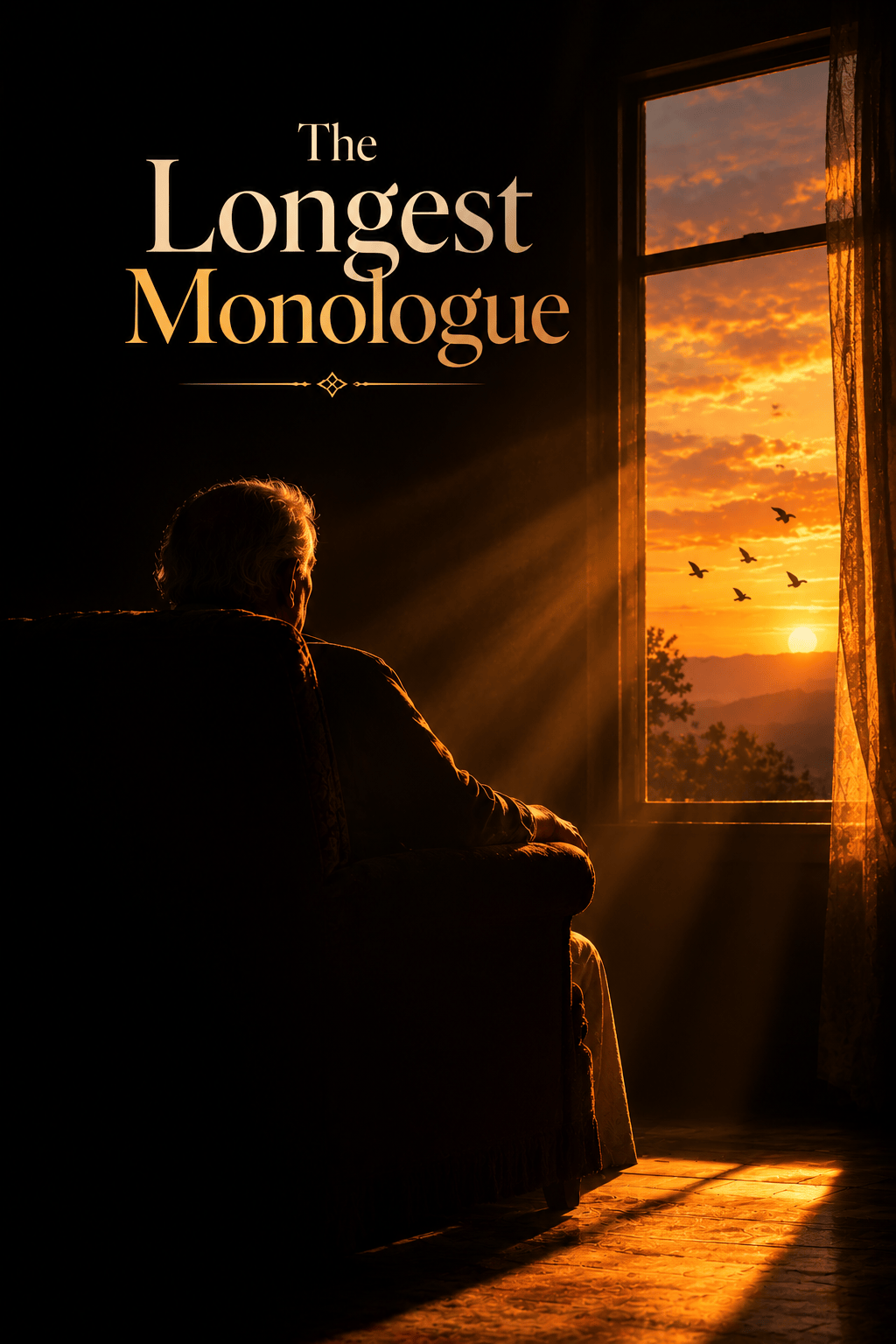
An armchair beside a window.
The room is almost completely swallowed by shadow. A few strong rays of sunlight enter through a narrow gap in the curtains, cutting through the darkness and illuminating the dust in the air.
An old man sits in the armchair, facing the window.
His face is barely visible.
One hand rests on the arm of the chair. His fingers tremble slightly.
He has lived for several decades.
Perhaps he has only a few moments left.
Yesterday, his thoughts became words.
And once they began, they did not stop.
It was the longest monologue of his life.
It began with anger.
—
“I don’t know what they expect me to feel.
They put a flag over my son’s coffin.
They called him a martyr.
They told me he had served his country with courage.
They told me I should be proud.
Proud.
What am I supposed to do with pride when my son is dead?
What good is a medal when the man who earned it cannot come home?
I remember holding it.
Cold metal.
That is what I remember.
Cold metal in my hand.
And I kept thinking—
this is what they gave me instead of my son.
A medal.
A flag.
A few words.
Sacrifice.
Duty.
Honour.
Beautiful words.
They make death sound almost respectable.
But death isn’t respectable when it is your child.
He was my son before he was their soldier.
He was a boy before he was their martyr.
And I was a father before I was anything else.
I wish someone had told me that.
I wish someone had told all of us.
We fought for this country.
I fought the British when I was young.
I believed in freedom.
I believed that if we endured enough, if we sacrificed enough, the children who came after us would inherit something better.
That belief carried me through things I cannot even remember properly anymore.
And look at us now.
Still poverty.
Still hunger.
Still children going to sleep without food.
Still families afraid of what might happen to their children on the streets.
Still crime.
Still people living from one day to the next, wondering whether tomorrow will be kinder.
Was this what we fought for?
Was this what all those young men dreamed about?
Sometimes I look around and feel cheated.
Not because freedom was meaningless.
Because I believed it would be enough.
I believed that once the chains were gone, everything else would follow.
Perhaps that was the foolishness of youth.
We knew how to fight for freedom.
We didn’t know how difficult it would be to build a life after winning it.
And my son…
He believed too.
Perhaps that is what hurts most.
He believed in something.
And now he is gone.
Sometimes I think I would never want to be born again.
Never.
Why come back?
Why become young again?
Why love again?
Why have children again?
Why build a life when you already know how it ends?
Everyone you love eventually leaves.
Everyone.
I know.
Because I have watched it happen.”
—
His voice slows.
The anger has begun to lose its force.
The room is still bright, but the sunlight has moved farther across the floor.
He looks down at his hand.
“Everyone…
My parents went first.
The famine of 1943.
I still remember the hunger.
Not mine.
Theirs.
My mother trying not to eat so there would be more for me.
My father pretending he wasn’t hungry.
I knew.
Children always know.
They just don’t know what to do with what they know.
I was young.
I thought I could save them.
I had fought the British.
I knew how to hide.
I knew how to run.
I knew how to stand my ground.
But what could I do against hunger?
There was no man to fight.
No soldier.
No gun.
Nothing I could point at and say, ‘This is the enemy.’
It was simply there.
Taking them away.
Day by day.
My mother became weaker.
My father became quieter.
And then they were gone.
Just like that.
Gone.
I think that was the first time I understood what helplessness meant.
Not fear.
Not weakness.
Helplessness.
Knowing that someone you love is disappearing in front of you and having absolutely nothing to give them.
Nothing.
I would have fought a thousand soldiers for them.
I would have given my life.
But hunger doesn’t fight back.
It simply takes.
And perhaps that is why I became so angry afterward.
I thought if I became strong enough, brave enough, useful enough, perhaps I would never again have to stand there and watch someone I loved disappear.
I was wrong.
Because years later, I stood there again.
Only this time it was my son.
And then, years after that…
my wife.”
—
The words become quieter.
“The pandemic.
Even saying it feels strange.
Such a small word for something that took so much.
There was no battlefield.
No gunfire.
No warning.
Just a hospital.
A telephone call.
And then…
nothing.
She was gone.
She had been beside me for so many years that I had forgotten what the world sounded like without her.
She knew everything.
The things I remembered.
The things I forgot.
The things I never told anyone.
She knew when I was angry even when I said I wasn’t.
She knew when I was afraid.
She knew when I was thinking about my son.
Sometimes she would simply sit beside me.
She didn’t need to ask.
She knew.
And then one day there was no one sitting beside me.
No voice.
No footsteps.
No one asking whether I had eaten.
No one telling me I was becoming too stubborn with age.
Just silence.
Her silence.
That was the hardest silence I have ever known.
And perhaps that is why I am afraid now.
Not of death.
Death and I have known each other for a long time.
I am afraid of what comes after.
What if there is nothing?
What if all of this—
all these years—
all these people—
all these memories—
end here?
What if I die and there is no one?
What if my wife is not there?
What if my son is not there?
What if my parents are not there?
I have spent my entire life losing people one at a time.
I don’t want to lose them twice.
I want to see her again.
Just once.
I don’t even need to speak to her.
I only want to see her.
I want to know that she is there.
I want to see my son.
I want to see my parents.
I want to know that all those people I loved did not simply disappear into nothing.
And if there is nothing…
then what?
Then I suppose I will finally understand what it means to be completely alone.”
—
The light has begun to change.
The hard sunlight has softened.
A warmer glow now enters through the window.
The old man looks toward it.
His voice remains fearful.
“But perhaps I am not ready to be alone yet.
Not here.
Not now.
I still have my grandchildren.
I want to see them again.
I want to hear them coming through that door.
I want to hear their footsteps.
Their voices.
Their laughter.
I want them to ask me questions I don’t know how to answer.
I want to complain about how noisy they are.
I want to pretend to be annoyed when they climb all over me.
I want…
I want another evening with them.
Just one.
And that is what frightens me.
What if this is my last evening?
What if tomorrow they come and I am not here?
What if the last thing they remember is this chair?
An empty chair.
I don’t want to become an empty chair.
I don’t want to become a photograph.
I don’t want them to say, ‘He used to sit here.’
I want to sit here.
With them.
For a little longer.
Just a little longer.”
—
He stops.
Outside, the Sun is sinking.
The room is no longer filled with harsh daylight.
Everything has become softer.
Orange light touches the edge of the window.
The old man watches it.
And something in his voice changes.
“Orange…
I remember orange.
Dusk.
I remember my first dusk.
I didn’t know it was my first.
I didn’t know that one day I would sit here, old and tired, trying to find it again.
I was a child.
I was running with my friend.
We were racing home before it became dark.
The wind was hitting our faces.
We were laughing.
I don’t remember what about.
We didn’t need a reason.
We were simply happy.
I remember the sky.
I remember the light.
I remember the feeling that the evening belonged to us.
I didn’t know then that childhood was already disappearing.
I wish I had known.
I would have looked longer.
I would have stayed outside a little more.
I would have remembered the sky.
And then there was another dusk.
My son.
He was still small.
I held him in my arms.
I remember looking at him while the Sun was going down.
His head rested against me.
He was quiet.
For once.
I remember thinking—
I have everything.
Everything.
I didn’t know how temporary everything was.
I didn’t know that one day I would sit here and remember that evening as though it were yesterday.
I didn’t know that the little boy in my arms would one day become a soldier.
I didn’t know that I would one day stand beside his coffin.
I only knew that I loved him.
Perhaps that was enough.
And then my grandchildren.
Their first dusk with me.
I remember holding my grandson for the first time.
His hand was so small.
He closed his fingers around mine.
Just like his father had once done.
For a moment, I could see both of them.
My son as a child.
My grandson in my arms.
Two different evenings.
Two different lives.
But the same hand.
The same warmth.
The same feeling.
And suddenly I understood something.
Perhaps we never really lose people completely.
Perhaps they continue through us.
My son’s hands became my grandson’s hands.
My wife’s laughter became something I hear in the children.
My mother’s tenderness lives somewhere in the way I hold them.
My father’s stubbornness…
Well.
That one seems to have survived perfectly.
I can hear it in myself.
And I remember the wind again.
That same wind from childhood.
I remember running with my friend.
I remember the rain when I fell in love.
Her laughter.
The wet road.
The way she looked at me.
And the snow…
God, the snow.
That night after our victory.
We were exhausted.
Cold.
Some wounded.
Some bleeding.
And still we laughed.
We threw snow at each other like children.
We forgot the war for one night.
We forgot tomorrow.
We were simply alive.
Together.
I remember their faces now.
The ones who never came home.
They were young.
So young.
And perhaps I have spent too many years remembering how I lost them.
I should remember how I knew them.
How they laughed.
How they argued.
How they sang.
How they stood beside me.
How they made terrible jokes in terrible places.
Those were the years.
Those were the moments.
That was life.”
—
The Sun is almost at the horizon.
His voice has become calm.
“I spent this morning counting everything life took from me.
My parents.
My hand.
My son.
My wife.
My youth.
My innocence.
And I thought I had been unlucky.
Perhaps I was.
But I was also lucky.
Very lucky.
Because you cannot lose what you never had.
I had parents.
I had a childhood.
I had friends.
I had a country worth believing in.
I had a wife.
I had a son.
I have grandchildren.
I have memories that survived decades.
I have known love.
And I have known the pain of losing it.
Maybe that is what a life is.
Not just what remains.
Everything that happened before it was lost.
I had forgotten that.
I was so busy mourning the empty places that I forgot how full my life once was.
How full it still is.
Even now.
Even sitting here.
I can close my eyes and hear them.
My father.
My mother.
My friends.
My wife.
My son.
My grandchildren.
All of them.
Still somewhere inside me.
And if there is another side…
if there really is something beyond this…
I hope she is there.
I hope my son is there.
I hope my parents are there.
But if there is nothing…
then I suppose I will still have had this.
This life.
These people.
These evenings.
These memories.
And you know what?
It was enough.
More than enough.
It was beautiful.
Not all of it.
God, no.
Some of it was terrible.
Some of it nearly broke me.
But the terrible things were not the whole story.
They were only part of it.
There was love too.
There was laughter.
There was rain.
There was wind.
There was snow.
There were hands holding mine.
There were people waiting for me to come home.
There were children running toward me.
There was a woman who knew me completely.
There was a boy who called me father.
There was a grandson who held my finger.
There was a friend running beside me beneath an evening sky.
What more could I have asked for?
Perhaps more time.
Yes.
I would still ask for more time.
But if this is all I get…
then I cannot complain.
No.
I cannot.
Oh…
It was all worth it.
Every bit of it.
I would do it again.
A hundred times.
A thousand times.
I would still choose this life.
I would still choose them.
Every single time.”
—
He stops.
The Sun touches the horizon.
The sky becomes pure orange.
A flock of birds crosses the fading light.
The curtain moves gently in the evening air.
His hand rests on the arm of the chair.
It is completely still.
For the first time since morning, there is no voice in the room.
The birds can be heard.
The wind.
The leaves.
His breathing.
The last ray of sunlight crosses the floor.
It touches the chair.
Touches his hand.
Then disappears.
Darkness returns.
The birds continue somewhere beyond the window.
The world continues.
Inside the room, there is only silence.
Pure silence.
After the longest monologue of his life, nothing remains to be said.
And for the first time all day, he does not speak.
He simply watches the last trace of orange disappear.
The Longest Monologue


Leave a Reply