Indian politics since Independence can be understood not merely as a succession of governments, elections and political parties, but as a succession of party systems. Each period had a distinctive political structure, and each structure created its own central question.
From the Congress-dominated years to the era of coalition governments and the emergence of BJP dominance at the national level, the basic question repeatedly changed:
How can a political party or political alliance hold together a country as socially, ideologically and regionally diverse as India?
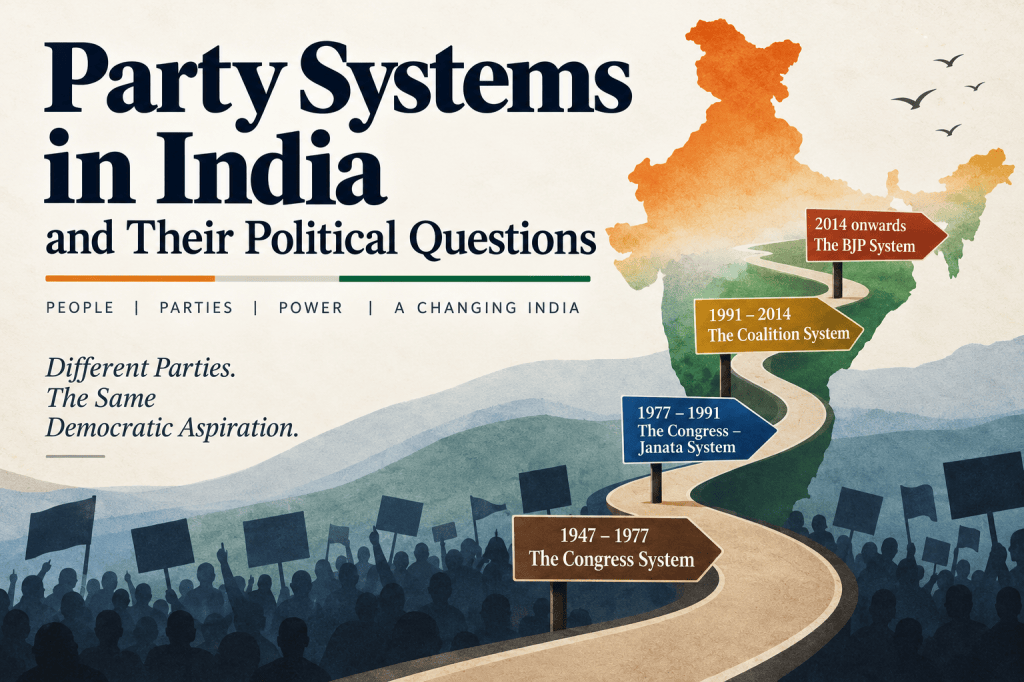
Seen from this perspective, post-Independence Indian politics can broadly be divided into four phases.
—
1. The Congress System: 1947–1977
The first phase of Indian politics was dominated by the Indian National Congress. Congress was much more than an ordinary political party. It functioned as a vast political umbrella containing groups with very different ideological, social and economic interests.
Landlords and peasants, industrialists and workers, socialists and conservatives, secularists and religiously oriented politicians, centrists and the Left could all find space within the Congress organisation.
This was possible partly because Congress had emerged from the freedom movement. It had a national organisational network and legitimacy that few other political organisations could match.
Outside Congress, there were numerous opposition parties: the Communist parties, Socialist parties, Jana Sangh and various regional and ideological formations. Yet none could challenge Congress’s national dominance for much of this period.
The central political question: Can the big tent stay together?
The biggest challenge for Congress was therefore not simply defeating the opposition. It was managing the contradictions within Congress itself.
A party containing such a wide spectrum of political interests needed an internal mechanism for balancing competing factions. Leadership, organisational negotiations, elections and distribution of political power became crucial to maintaining unity.
The 1969 split demonstrated how difficult this balancing act could become. The conflict between Indira Gandhi and the Congress organisation culminated in the party’s division into competing factions.
The 1975–77 Emergency and the political developments surrounding the 1977 election produced an even more fundamental rupture in the Congress system. Congress lost power nationally for the first time, while several opposition parties came together under the Janata banner.
Thus, the first party system raises a fundamental question:
Can a single big-tent party continuously accommodate competing ideologies, classes, regions and political ambitions without eventually breaking apart?
—
2. The Congress–Janata System: 1977–1991
The 1977 election marked a major transformation.
Several opposition parties that had previously competed against one another came together to form the Janata Party. The Congress remained a major national force, creating a political competition between two broad formations.
A similar process occurred again in 1989, when several parties came together around the Janata Dal, while the BJP emerged as a separate major force. The exact composition of the two national formations changed over the period, but the larger political phenomenon was similar: parties with different origins attempted to operate within a common political framework.
The Janata experiment was particularly significant because its constituent groups had very different political histories and ideological traditions.
The central political question: Can former rivals become one party?
The challenge of the Congress system had been holding together factions inside one large party.
The challenge of the Janata era was somewhat different: could politicians belonging to different parent organisations genuinely become members of one political party?
The Janata Party contained leaders and organisations with different traditions, including the former Congress (Organisation), Bharatiya Jana Sangh, Bharatiya Lok Dal and Socialist streams.
Their differences did not disappear simply because they had adopted a common party label.
The Janata government eventually collapsed in 1979 amid internal conflict. The later history of the Janata family was similarly marked by fragmentation. The developments surrounding the Janata Dal after 1989 again demonstrated the difficulty of maintaining a common organisation among leaders with different political backgrounds and ambitions.
This produced the second great political question:
Can political parties formed by bringing together previously competing organisations develop a common identity strong enough to survive differences among their leaders and ideological traditions?
—
3. The Coalition System: 1991–2014
The third phase was characterised by the growing importance of coalition politics.
The political landscape became increasingly fragmented. Regional parties became powerful in their respective states and increasingly important at the national level. Neither Congress nor BJP could consistently dominate the Lok Sabha during much of this period.
Governments consequently depended on alliances and the support of other parties.
The period saw a succession of coalition arrangements, including governments led by P. V. Narasimha Rao, H. D. Deve Gowda, I. K. Gujral, Atal Bihari Vajpayee, Manmohan Singh and others. Some governments completed their terms, while others were short-lived.
It is therefore important to distinguish two things: coalition government itself did not always mean instability. The later UPA governments, for example, completed full terms. Nevertheless, the early and middle years of the coalition era demonstrated how difficult it could be to construct and maintain stable parliamentary majorities.
The central political question: Can diverse parties govern together?
Coalition politics created a new political problem.
India’s diversity was now reflected not only within parties, but also between parties.
Regional parties could bring state-specific interests to the national government. Smaller parties could become crucial to parliamentary majorities. National parties had to negotiate with political organisations whose priorities were sometimes very different from their own.
The political question therefore became:
Can a government reconcile national policy with the competing ideological, regional and institutional interests of its coalition partners?
Coalition politics also changed the nature of political bargaining. A government could have a clear leader and a common programme, yet remain dependent upon parties outside its own organisation.
In this sense, the coalition era represented not simply instability, but also a deeper federalisation of national politics.
—
4. The BJP System: 2014 Onwards
The 2014 Lok Sabha election produced another major transformation.
The Bharatiya Janata Party won a clear majority on its own, becoming the first party other than Congress to win a single-party majority in the Lok Sabha since 1984. The BJP repeated this achievement in 2019, although the 2024 election produced a different parliamentary configuration in which the BJP remained the largest party but did not itself cross the majority mark and formed the Union government with allies.
This period can therefore be described as an era of BJP-led national dominance, rather than assuming uninterrupted single-party majorities throughout the entire period.
What distinguishes this phase from the earlier Congress system is the ideological and organisational character of the dominant party. Congress historically operated as a broad umbrella containing multiple ideological tendencies. The BJP, by contrast, has a more clearly articulated ideological identity associated with Hindutva and the wider Sangh Parivar ecosystem.
The central political question: Can an ideology-based national party accommodate India’s diversity?
The political challenge is consequently different from that faced by Congress.
Congress had to constantly manage ideological diversity within the party.
The BJP’s challenge is different: how does an ideologically defined national party translate its political vision into a governing framework for a country characterised by enormous religious, linguistic, caste, regional and cultural diversity?
This question has several dimensions.
How does a national ideological narrative interact with regional identities?
How does ideological mobilisation coexist with India’s constitutional commitment to pluralism?
And how does a nationally dominant party maintain political support across social groups who were part of opposing political formations in past and whose interests may differ substantially?
These questions are likely to remain central to understanding Indian politics in the current era.
—
From One Political Question to Another
The four party systems can therefore be understood through the problem each one faced. This interpretation also reveals an interesting continuity. Every party system in India has had to solve the problem of diversity. The Congress system tried to accommodate diversity inside one party. The Janata experiments tried to accommodate diversity among previously separate political organisations. The coalition era accommodated diversity through alliances among independent parties. The BJP-led era has brought back stronger national-party dominance, but with its unique ideological narrative.
—
The Larger Political Question
Indian democracy has never had a permanently fixed party system. Party systems have changed over the eight decades of Indian Democracy. The most interesting way to study these changes may therefore be to move beyond the question of which party won an election and ask a deeper question:
What political structure can successfully convert India’s extraordinary diversity into a workable system of democratic government?
That question connects the entire history of Indian party politics.
The Congress experiment answered it through a broad political umbrella.
The Janata experiment attempted to answer it through political unification.
Coalition politics answered it through negotiation among multiple parties.
The BJP-led era is providing another answer through a nationally organised, ideologically defined political formation.
None of these models should be treated as permanently settled. Indian politics remains dynamic, and the relationship between national parties, regional parties, social groups, ideology and institutions will continue to shape the country’s party system.
Ultimately, the history of Indian party politics is not simply a history of Congress, Janata, BJP or coalitions.
It is the history of India’s continuing attempt to answer one extraordinarily difficult democratic question:
How can political power be organised in a country where political diversity is almost as vast as the country itself?
Party-systems in India : 4 Phases of Indian Democratic politics
Response
-
India’s changing party systems offer a broader lesson about political power: winning elections, maintaining a governing majority, and building a durable political system are three different achievements.
The Congress era attempted to manage diversity within a broad political umbrella. The Janata experiments tested whether previously competing organizations could sustain a common political identity. Coalition politics distributed influence among national and regional parties, while the BJP-led era introduced a different model of national political dominance, with a more clearly defined ideological identity.
Yet the central question extends beyond which party leads the government. It concerns the institutional capacity to manage competing interests, protect political participation, accommodate regional aspirations, and maintain public confidence in democratic rules.
A majority can make decision-making easier, but it does not automatically resolve social divisions. Coalitions can complicate governance, but they can also provide channels through which diverse interests participate in national decision-making. The strategic significance of any party system therefore depends not only on how power is acquired, but also on how it is exercised, constrained, and translated into durable political outcomes.
From a systems perspective, the real test is whether a political arrangement can absorb disagreement without turning every contest into an existential struggle. When opposition is treated as a legitimate component of democratic life, institutions retain room for adaptation. When political competition becomes a struggle to exclude or permanently subordinate rival constituencies, electoral victories may coexist with deeper institutional tensions.
India’s experience raises a question relevant to diverse societies everywhere: Can a political system convert electoral authority into lasting legitimacy without requiring social and ideological uniformity?
The answer depends not simply on the dominance of a party or the structure of an alliance, but on whether institutions can reconcile political competition with inclusion, accountability, and the peaceful transfer of power. That is the distinction between winning a political cycle and sustaining a democratic system.
LikeLike


Leave a Reply