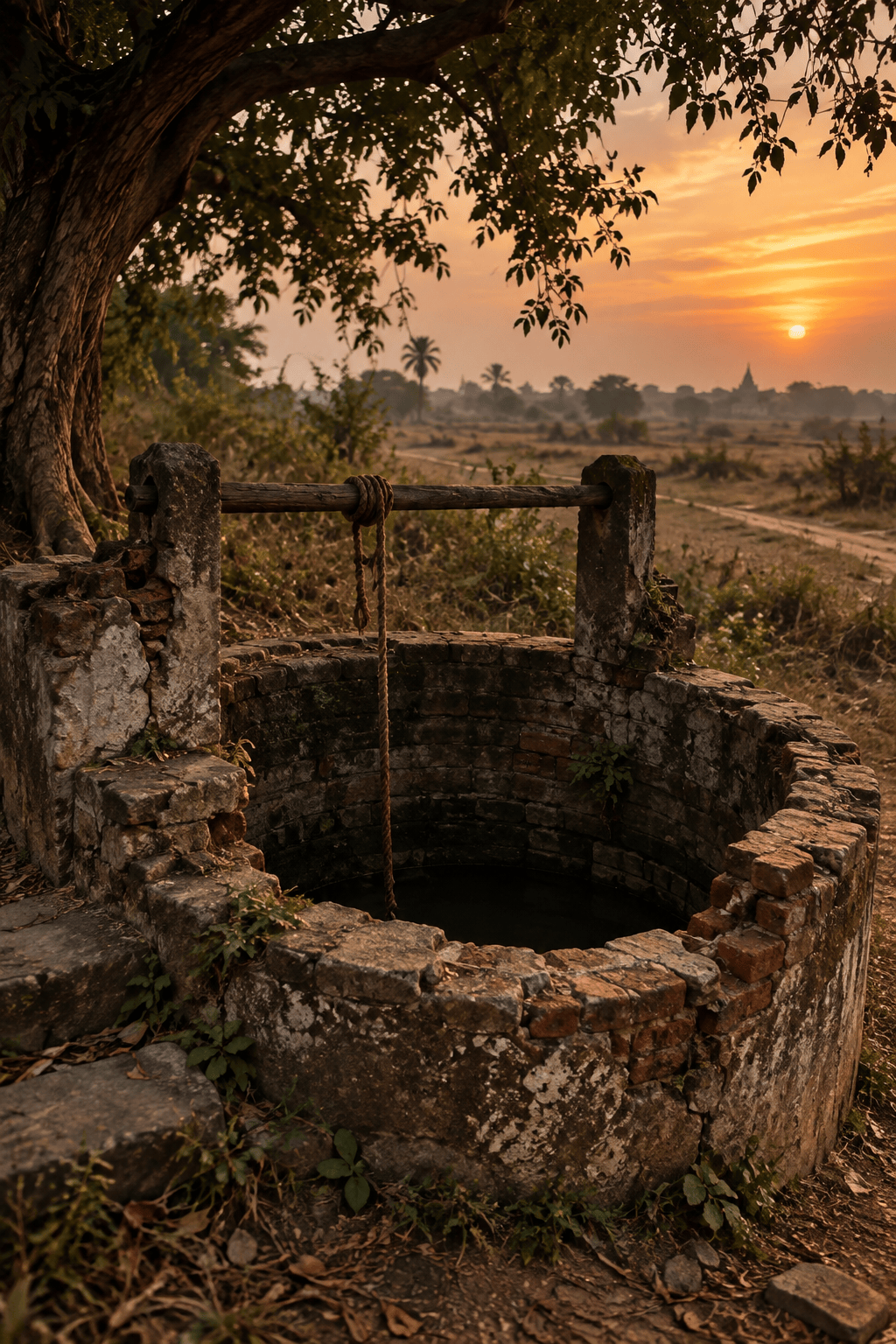
At the edge of the village, where the last houses gave way to the fields, stood an old stone well.
No one knew exactly how old I was.
The elders said a great saint had stopped there centuries ago, struck the earth with his staff, and blessed the water. Others said the well had been there long before the saint ever came.
No one argued about it anymore.
They simply called me the Saint’s Well.
There was a tea stall a little way from me, under a neem tree. Four wooden benches, a blackened kettle, two glass jars of biscuits, and a tin roof that rattled whenever the wind came down from the plateau.
Between the tea stall and me ran the road that everyone used.
People came to me when they wanted something.
They went to the tea stall when they wanted to talk about it.
The first person to come that morning was Sajjan.
He looked around before approaching, although there was nobody nearby.
He crouched beside me and took a coin from his pocket.
“Let Bheem get that job in Indore.”
He paused.
“Let him go soon.”
Another pause.
“And let him forget Ekta.”
The coin dropped.
It struck the water once and disappeared.
Sajjan stood up, brushed the dust from his knees and walked straight to the tea stall.
Bheem was already there.
“You’re late,” Bheem said.
“I had work.”
“You? What work?”
Sajjan pulled out the empty chair beside him.
“Drink your tea.”
Bheem laughed.
They had been friends since childhood. They sat shoulder to shoulder, argued over cricket, borrowed money from each other and knew which houses kept the best pickles.
The tea stall owner put another glass in front of Sajjan.
Bheem pushed the biscuit jar toward him.
“You take the last one.”
“You take it.”
“You always say that.”
“Then take it.”
They both laughed.
Neither knew what the other had asked for that morning.
Or perhaps each suspected.
Across the road, Ekta passed with a stack of books against her chest.
Bheem stopped talking.
Sajjan looked at his tea.
The tea stall owner looked at both of them and said nothing.
Ekta did not look toward the stall.
She walked on.
—
Deepak came to the well the next afternoon.
He was carrying a brass lota.
He filled it, placed it beside the wall and stood looking into the water.
He did not speak immediately.
Then he took a coin from his pocket.
“Keep her well.”
He dropped it.
“Let her be happy.”
Another coin.
“Let her husband take care of her.”
He stayed there for a while.
Then he picked up the lota and went home.
Everyone in the village knew about Renu.
They knew Deepak had once wanted to marry her. They knew his parents had refused. They knew the matter had ended when another family came for him and the elders decided that Gauri was the right match.
Nobody talked about it much anymore.
Least of all Deepak.
He never brought Renu’s name into his house.
Not once.
Gauri knew enough without asking.
That evening, she was kneading dough when Deepak came in.
“You’ve come early,” she said.
“Work finished.”
She put another piece of wood into the stove.
“Wash your hands.”
He did.
Later, when they sat down to eat, Gauri noticed that he had left the best piece of roti for her.
“You eat it.”
“I’ve eaten.”
“You haven’t.”
“I have.”
She pushed it back.
He pushed it toward her again.
She finally took it.
The next morning, Deepak left before sunrise.
Gauri watched from the doorway until he disappeared beyond the houses.
—
At the tea stall, Sajjan and Bheem were joined by Bakul and Nakul.
The twins looked so alike that even the tea stall owner sometimes put the glasses down and waited for them to decide whose was whose.
“You take the stronger tea,” Bakul said.
“You always say that.”
“Because you like it.”
“You like it too.”
“Then give it to me.”
Nakul pushed his glass toward him.
Bakul pushed it back.
They laughed.
Everyone in the village spoke well of them.
Two brothers who never quarrelled.
Two brothers who worked together.
Two brothers who would never let land come between them.
That evening Bakul came to me.
He looked toward the fields.
Then toward the road.
Then he took out a coin.
“Let Nakul take the eastern field.”
He lowered his voice.
“Let the western field come to me.”
The coin disappeared into the water.
The following evening, Nakul stood in the same place.
“Let Bakul take the eastern field.”
He smiled faintly.
“And let the western field come to me.”
He dropped his coin.
The water swallowed both wishes without preference.
—
At the tea stall the next morning, the four men sat together.
Bakul was telling a story.
Nakul interrupted him.
“You always leave out the important part.”
“You don’t know the important part.”
“I was there.”
“You were asleep.”
Sajjan laughed.
Bheem slapped the bench.
The twins laughed too.
For a moment, the four of them looked like boys again.
Then Ekta arrived.
She placed her books on the bench.
“Tea.”
The tea stall owner poured it.
Bheem moved aside to make room.
Sajjan moved too.
Ekta looked at both of them.
“There is enough space. You don’t both have to move.”
They looked at each other.
She shook her head and opened her book.
“What are you reading?” Bheem asked.
“History.”
“Why?”
“Because I like it.”
“You’ll become a teacher?”
“Maybe.”
“What else?”
“Maybe I’ll go to the city.”
The two men became quiet.
Ekta took a sip of tea.
“I want to study properly.”
Sajjan looked at Bheem.
Bheem looked at Sajjan.
Ekta noticed.
“What?”
“Nothing,” they said together.
She laughed.
—
A few days later, Ekta came to me alone.
There was no coin in her hand at first.
She looked back toward the village.
“I don’t want a husband from here.”
She sat on the stone ledge.
“I want to study.”
She picked up a coin.
“I want to see the city.”
She dropped it.
“I want to know what is beyond this road.”
Another coin.
She listened to the water.
Then she left.
—
The tea stall remained the place where everyone pretended nothing had happened.
Sajjan and Bheem still sat together.
Bakul and Nakul still shared meals.
Ekta still came with her books.
Deepak still drank tea without sugar.
Gauri sometimes stopped by on her way back from the market.
Nobody knew what anyone had asked me.
But the wishes did not always remain wishes.
The government surveyors arrived first.
Then the men with measuring chains.
Then the white-painted stones appeared along the fields.
The road would be widened.
A development project would come through the village.
Several fields would have to go.
Including the eastern field.
And the western field.
Bakul and Nakul stood at the edge of their land that afternoon.
Neither spoke.
Finally Bakul said,
“So.”
Nakul looked at him.
“So.”
A week later, the papers were signed.
The brothers received their compensation.
The fields were gone.
At the tea stall, they sat together.
Bakul ordered two teas.
Nakul took one.
“Yours has more sugar.”
“You gave it to me.”
“I know.”
They smiled.
Neither mentioned the fields.
—
Ekta’s wedding was fixed that same year.
A family from another village.
Her books disappeared slowly from the tea stall.
Then from the courtyard.
Then from the house.
One evening she came to the well.
She was wearing a new sari.
She stood very still.
“I wanted to study.”
She looked into the water.
“I still do.”
Her fingers tightened around the coin.
“Let me go.”
The coin fell.
After that, the wedding preparations began.
At the tea stall, Bheem and Sajjan sat quietly.
“You’re going?”
Bheem nodded.
“You?”
“Of course.”
Neither smiled.
On the wedding day, both stood near the entrance with the other young men of the village.
They carried chairs.
They brought water.
They laughed when the priest made a mistake.
When Ekta left, she did not look toward either of them.
Years later, people would say she had gone to the city.
Some said she was studying.
Some said she had found work.
Nobody knew exactly.
Sajjan and Bheem continued sitting together at the tea stall.
One afternoon, Bheem said,
“Tea?”
Sajjan nodded.
“Tea.”
—
Deepak’s visits to the well became less frequent.
When he came, his wishes changed slowly.
At first there were still the same words.
“Keep her well.”
Then:
“Let her be happy.”
Then:
“Let her husband be kind.”
After some time, he stopped saying the last part.
He simply stood there.
One evening, he brought two coins.
He looked at them for a long time.
He dropped one.
Then the other.
He said nothing.
At home, Gauri was waiting with dinner.
“You’re late.”
“I know.”
“The food is cold.”
“I’ll eat.”
She moved the bowl closer.
He sat down.
She noticed a tear in his shirt.
“Give it to me.”
“I’ll fix it.”
“You won’t.”
“I will.”
“You’ll forget.”
He smiled.
“Then remind me.”
She took the shirt.
—
Gauri came to the well alone one winter morning.
She wore the same old shawl she used when going to the temple.
She looked around before coming closer.
Nobody was there.
She placed both hands on the stone edge.
“Is Chandan well?”
The village had never heard that name from her.
Deepak had never heard it.
She had never spoken it at the tea stall.
She had never spoken it in her mother’s house.
Only here.
She waited.
“Does he still live there?”
A coin fell.
“Is he happy?”
Another coin.
She closed her eyes.
“Please let him be happy.”
She left before the sun had reached the top of the neem tree.
—
At the tea stall that afternoon, Deepak sat with Sajjan and Bheem.
The three men talked about the harvest.
Gauri came past carrying vegetables.
Deepak saw her.
“You’re going home?”
She nodded.
“I’ll come.”
She walked on.
Bheem smiled.
“Your wife waits for you.”
Deepak picked up his tea.
“She always does.”
There was no embarrassment in his voice.
No explanation either.
—
Gauri returned to the well some weeks later.
“Is he well?”
She dropped a coin.
“Let him be happy.”
Another.
She remained there longer this time.
When she returned home, Deepak was repairing the broken latch on the courtyard gate.
“You should have told me,” she said.
“It was only the latch.”
“You could have hurt yourself.”
He looked at her.
“I didn’t.”
She stood beside him.
“Move.”
“Why?”
“You’re doing it wrong.”
He moved.
She took the tool from his hand.
He watched her repair it.
Neither spoke.
—
The years moved.
The road grew wider.
The tea stall got a new roof.
The old benches were replaced.
The village gained two motorcycles, three televisions and a shop selling mobile phones.
The well remained where it had always been.
Sajjan still came.
So did Bheem.
They were older now.
One evening Sajjan said,
“Remember when you were going to Indore?”
Bheem laughed.
“You were the one who wanted to send me.”
“I never said that.”
“You did.”
“You’re imagining things.”
They laughed.
Neither asked what the other had once wished.
They still sat together.
—
Bakul and Nakul came less often.
When they did, they came together.
One afternoon they stood beside the well.
“Remember the eastern field?” Bakul asked.
Nakul laughed.
“Remember the western one?”
They looked at each other.
Then both laughed again.
“Tea?” Nakul said.
“Tea.”
They walked toward the stall.
—
Ekta came back once.
She stood at the tea stall wearing spectacles.
Sajjan almost did not recognize her.
Bheem stared.
“You came.”
“Yes.”
“From the city?”
“Yes.”
“What are you doing there?”
“Studying.”
Sajjan smiled.
“That is good.”
She looked at him.
“Is it?”
“Yes.”
Bheem handed her a glass of tea.
“You still take less sugar?”
She looked surprised.
“You remember?”
He shrugged.
She drank.
The three of them sat together for a while.
No one mentioned the wedding.
No one mentioned the years between.
When she left, Sajjan and Bheem watched her walk toward the bus stand.
“Tea?” Bheem said.
Sajjan nodded.
“Tea.”
—
Deepak and Gauri grew older without noticing.
There were no grand changes.
He began waiting for her when they went to the market.
She began keeping aside the part of the meal he liked.
When he returned late, she left the lamp burning.
When she was ill, he stopped going to the fields.
When his cough worsened one winter, she sat beside him until he slept.
The tea stall noticed these things.
The village noticed some of them.
Neither Deepak nor Gauri spoke of them.
Gauri still came to the well sometimes.
For a long time, her coins carried the same name.
Then one day she came and stood there without speaking it.
She held the coin.
Her lips moved.
No sound reached the water.
She dropped it.
—
Deepak came the next evening.
He stood for a long time.
The sun was going down behind the fields.
He took a coin from his pocket.
“Keep her well.”
He dropped it.
Then he remained there until the water became dark.
—
The next week, Deepak and Gauri came to the well together.
Neither had planned it.
At least neither said so.
They stopped a few steps apart.
Gauri looked at him.
“You came?”
“Yes.”
She looked toward the water.
He looked toward the village.
Gauri took out a coin.
Deepak did the same.
They stood quietly.
Deepak stepped forward first.
He held the coin between his fingers.
“Keep her well.”
He dropped it.
Gauri came to the edge.
She looked into the water.
“Keep him well.”
Her coin fell.
The ripples touched the old stone and disappeared.
Neither said anything.
They walked back toward the village.
At the neem tree, Deepak slowed.
Gauri slowed too.
The road ahead was darkening.
They continued side by side.
Behind them, the tea stall was closing.
Ahead of them, the first lamps were coming on in the houses.
I remained where I had always been.
The water settled.
And the road carried them home.
The Well of Wishers


Leave a Reply