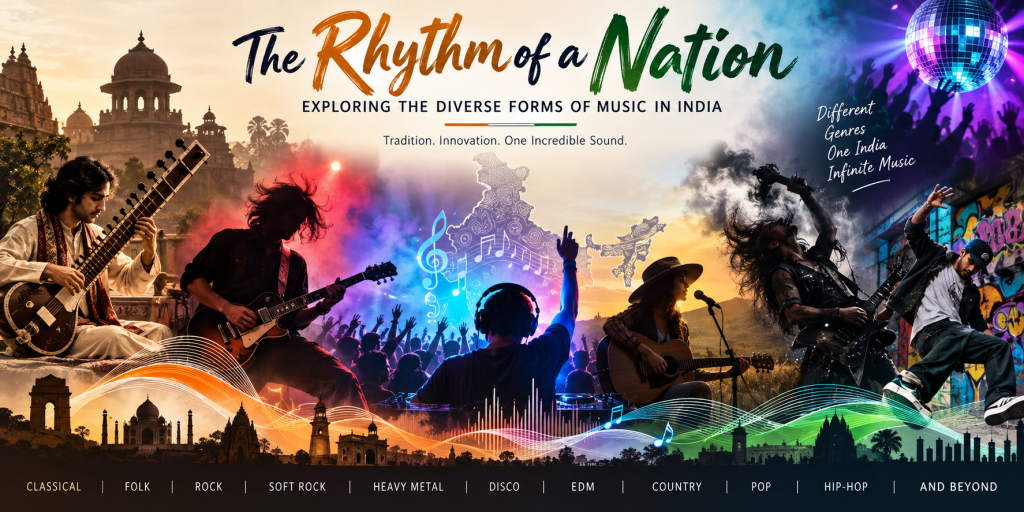
From the timeless melodies of Indian classical music to the electrifying beats of EDM, India’s musical landscape is a vibrant celebration of culture, creativity, and diversity.
A Nation That Speaks Through Music
India is a land of extraordinary musical diversity. From the soulful sounds of a sitar to the energetic rhythms of rock and roll, music has always played an important role in the country’s cultural identity. It brings people together, expresses emotions, tells stories, and connects generations.
Over the years, India has embraced a wide variety of musical genres, including classical, folk, rock and roll, soft rock, heavy metal, disco, electronic dance music (EDM), country, jazz, hip-hop, and pop. While some of these genres have deep roots in Indian traditions, others arrived from different parts of the world and evolved into distinctive Indian expressions.
Today, Indian music is not confined to a single style. It is a fascinating blend of tradition and modernity, where ancient ragas coexist with electronic beats and traditional instruments find their place alongside electric guitars and synthesizers.
Let’s explore some of the most popular and influential forms of music in India.
1. Indian Classical Music: The Soul of Tradition
Indian classical music is one of the oldest and most sophisticated musical traditions in the world. It is deeply connected to spirituality, philosophy, and the emotional expression of human experiences.
There are two major traditions of Indian classical music:
A. Hindustani Classical Music
Predominantly practised in North India, Hindustani classical music emphasizes improvisation, melodic development, and the exploration of ragas. Instruments such as the sitar, tabla, sarod, bansuri, and sarangi play important roles in this tradition. Legendary musicians such as Ravi Shankar, Bismillah Khan, and Bhimsen Joshi helped introduce Indian classical music to audiences around the world.
B. Carnatic Classical Music
Originating in South India, Carnatic music is known for its intricate compositions, rhythmic complexity, and devotional themes. It features instruments such as the veena, violin, mridangam, and ghatam.
Artists such as M. S. Subbulakshmi, Lalgudi Jayaraman, and T. M. Krishna have contributed to its rich musical heritage. Indian classical music continues to inspire contemporary musicians, film composers, and experimental artists, proving that tradition can remain relevant in a rapidly changing musical world.
2. Rock and Roll: The Spirit of Rebellion
Rock and roll emerged in the United States during the 1950s and gradually found its way into India’s urban music culture. With its energetic rhythms, electric guitars, and rebellious spirit, it attracted young listeners looking for something different from conventional musical styles.
In India, rock and roll helped lay the foundation for a wider rock music movement. Over time, Indian musicians began combining Western rock influences with local languages, melodies, and cultural themes. In Bollywood film music, rock n roll made its entry with songs such as Eena Meena Deeka, Aao Twist Karein, etc.
Bands such as The Great Bear and later Indian rock acts helped develop the country’s independent music scene. Today, rock music can be heard at college festivals, live music venues, and major music events across India.
The appeal of rock and roll lies in its raw energy, emotional honesty, and ability to bring audiences together through powerful performances.
3. Soft Rock: Melodies That Touch the Heart
Soft rock offers a gentler side of rock music. It combines the familiar sounds of guitars, drums, and keyboards with smooth melodies, thoughtful lyrics, and a relaxed musical atmosphere.
In India, soft rock has found a strong audience among listeners who enjoy melodic songs, romantic themes, and emotionally expressive performances. In film music many soft rock songs were inspired from Beatles and Presley. Songs such as Dekho ab to kisi ko nahi hai khabar (inspired from I want to hold your hand), Kaun hai Jo sapno me aaya (inspired from Margharita) are earliest of such examples.
Artists and bands such as Euphoria, Indus Creed, and various independent acoustic performers have explored melodic rock sounds, sometimes blending them with Indian musical elements.
Soft rock is especially popular among listeners who appreciate music that is soothing without being overly simple. It is equally suited to a quiet evening, a long drive, or a live acoustic performance. Its lasting charm lies in its ability to communicate emotions through memorable melodies and meaningful lyrics.
4. Heavy Metal: Power, Passion, and Intensity
Heavy metal is one of the most energetic and technically demanding forms of modern music. Characterized by distorted electric guitars, powerful drums, intense vocals, and complex arrangements, it has developed a dedicated following in India.
Indian metal bands have explored a range of styles, including thrash metal, progressive metal, death metal, and folk metal.
Some notable Indian metal acts include:
Bloodywood: Known for blending metal with Punjabi folk influences, traditional percussion, and socially conscious lyrics.
Demonic Resurrection: A pioneering Indian extreme metal band known for its elaborate compositions.
Kryptos: A Bengaluru-based band associated with traditional heavy metal and thrash metal.
Skyharbor: Known for progressive metal and technically intricate musical arrangements.
Heavy metal in India is more than loud guitars and aggressive rhythms. For many fans, it represents artistic freedom, community, and a powerful way to express identity and emotion. In Bollywood Film Music, Heavy metal and hard rock made its entry through the movie Rock On !! followed by Rockstar. But most of heavy metal music is played by Bands.
The Indian metal scene has also gained international recognition through concerts, festivals, and performances beyond the country.
5. Disco: The Dance Music
Disco became a major musical and cultural phenomenon in India during the late 1970s and 1980s. Its infectious beats, funky basslines, orchestral arrangements, and dance-friendly rhythms transformed popular entertainment.
One of the most influential figures in Indian disco was Bappi Lahiri, whose music helped popularize disco-inspired sounds in Hindi cinema. Films such as Disco Dancer brought disco into the mainstream, while songs like “I Am a Disco Dancer” became enduring dance anthems.
Disco also influenced fashion, nightlife, film choreography, and the development of India’s electronic and dance music culture. Although its popularity has evolved over time, disco remains a nostalgic favorite and continues to inspire contemporary remixes, retro parties, and Bollywood dance tracks.
6. Electronic Dance Music (EDM): The Sound of a Generation
Electronic Dance Music, commonly known as EDM, has become an important part of India’s contemporary music scene. Built around electronic instruments, synthesizers, digital production, and powerful rhythmic patterns, EDM is designed to create immersive musical experiences, especially in live settings.
India’s EDM culture has grown through music festivals, clubs, concerts, and digital platforms. Artists such as Nucleya, Lost Stories, and Anish Sood have helped shape India’s electronic music landscape. Nucleya, in particular, is known for combining electronic production with Indian sounds, including regional rhythms and folk-inspired elements.
EDM includes several subgenres, such as:
– House
– Techno
– Trance
– Dubstep
– Drum and bass
– Progressive house
From large-scale festivals to intimate club performances, EDM has become a defining sound of India’s urban youth culture. Its popularity also reflects the growing influence of digital technology on how music is created, performed, and experienced.
7. Country Music: Stories of Life, Love, and the Open Road
Country music originated in the United States and is known for its storytelling, acoustic instruments, and themes of love, family, rural life, and personal experiences. Although country music is not traditionally an Indian genre, it has found listeners among Indian audiences who enjoy acoustic music and narrative-driven songwriting.
Country music often features guitars, banjos, fiddles, and harmonicas. Its simple yet expressive musical style makes it accessible to listeners across different backgrounds. In India, country influences can be found in acoustic performances, independent music, and Western music communities. Some Indian artists and bands explore country, folk, and Americana-inspired sounds, while others incorporate country-style storytelling into contemporary songwriting.
The connection between country music and Indian folk traditions is particularly interesting. Both often focus on everyday life, relationships, community, and the emotional experiences of ordinary people. This shared emphasis on storytelling creates opportunities for musical fusion between the two traditions.
8. Indian Folk Music: The Voice of rural India
India’s folk music is as diverse as its languages, landscapes, and communities.
Folk music has traditionally been passed down through generations and is closely associated with festivals, weddings, agricultural activities, religious celebrations, and local storytelling.
Some well-known folk traditions include:
Bhangra: An energetic Punjabi music and dance tradition associated with celebration and harvest.
Baul Music: A mystical and spiritual musical tradition from Bengal.
Rajasthani Folk Music: Known for expressive vocals and instruments such as the kamaicha and khartal.
Lavani: A lively musical and dance tradition from Maharashtra.
Bihu Music: A festive musical tradition associated with Assam’s Bihu celebrations.
Indian folk music has also influenced Bollywood, independent music, fusion bands, and electronic music producers. Its rhythms and melodies continue to provide inspiration for musicians who want to connect modern sounds with India’s cultural roots.
9. Bollywood Music: A Genre of Its Own
Bollywood music is one of the most recognizable forms of popular music in India. Closely associated with Hindi cinema, it combines elements of classical, folk, pop, rock, disco, hip-hop, and electronic music. One of Bollywood music’s defining characteristics is its ability to adapt to changing musical trends. From the orchestral compositions of earlier decades to the disco sounds of the 1980s and the electronic influences of contemporary film music, Bollywood has continually reinvented itself.
Composers such as R. D. Burman, A. R. Rahman, Pritam, and Shankar–Ehsaan–Loy have explored different musical styles and contributed to the evolution of Indian film music. Bollywood songs often become cultural phenomena, influencing fashion, dance, language, and social celebrations. Its combination of storytelling, melody, and visual performance makes it a distinctive part of India’s musical identity.
10. Indian Pop and Indie Music: Beyond the Mainstream
Indian pop music grew significantly during the 1990s, when independent albums and music videos became increasingly popular.
Artists such as Alisha Chinai, Daler Mehndi, and Lucky Ali helped establish Indian pop as a major musical movement outside film soundtracks. In recent years, independent music, often called indie music, has expanded rapidly through streaming platforms, social media, and live performances. Artists such as Prateek Kuhad, When Chai Met Toast, and The Local Train have developed audiences through distinctive songwriting and independent releases. Indian indie music includes a wide range of styles, from acoustic pop and alternative rock to electronic music and experimental fusion. This growing scene gives musicians greater freedom to explore personal themes, regional languages, and unconventional sounds.
11. Jazz, Blues, and Fusion: Music Without Borders
Jazz and blues have influenced musicians around the world, including those in India. Jazz is known for improvisation, sophisticated harmonies, and rhythmic experimentation, while blues often emphasizes expressive vocals, emotional storytelling, and distinctive guitar techniques.
India has developed a vibrant jazz scene, particularly in cities such as Mumbai, Delhi, Bengaluru, and Kolkata. Indian musicians have also experimented with fusion, bringing together jazz, blues, rock, and classical traditions. One well-known example is Shakti, the pioneering group featuring John McLaughlin and Indian musicians including Zakir Hussain and L. Shankar. Their music combined Indian classical traditions with jazz improvisation, creating a distinctive sound that attracted international audiences. Fusion music demonstrates how different musical traditions can interact while retaining their individual identities.
Jazz music was very popular in Bollywood film songs such as Aaiye Meherbaan, Babuji Dheere Chalna, Muskaan Jhoothi hai, Kaisi Paheli Zindagani, etc.
12. Hip-Hop and Rap: The Voice of Urban India
Hip-hop and rap have become increasingly influential in India, particularly among younger audiences. With rhythmic spoken vocals, strong beats, and lyrics focused on personal experiences and social realities, hip-hop offers a powerful platform for self-expression. Indian hip-hop includes artists performing in Hindi, Punjabi, Marathi, Tamil, Malayalam, and many other languages.
Artists such as Divine, Naezy, Emiway Bantai, and Raja Kumari have contributed to the growth and visibility of Indian rap. The rise of independent music platforms and films such as Gully Boy helped introduce Indian street rap to wider audiences.
Today, Indian hip-hop encompasses a variety of sounds, including trap, boom bap, melodic rap, and regional hip-hop. It reflects the experiences, ambitions, and creativity of a generation using music to tell its own stories.
The Future of Music in India
India’s musical future is likely to be shaped by a combination of technology, cultural exchange, and artistic experimentation. Streaming platforms have made music from different regions and genres more accessible than ever before. Independent artists can now reach audiences without depending entirely on traditional music labels. At the same time, collaborations between classical musicians, folk performers, rock bands, and electronic producers continue to create new musical possibilities. Artificial intelligence, digital production tools, and virtual performances are also opening new avenues for music creation and distribution. Yet, despite these technological changes, the emotional power of music remains unchanged. Whether it is a classical raga performed on a sitar, a heavy metal guitar solo, a disco beat, or a soulful country ballad, music continues to connect people through shared feelings and experiences.
One Nation, Many Rhythms
India’s musical landscape is a celebration of diversity. Each genre has its own history, sound, and audience, yet all contribute to the country’s rich cultural expression. Indian classical music preserves centuries-old traditions, rock and metal celebrate experimentation and intensity, disco and EDM bring people together through dance, while folk, country, hip-hop, and indie music tell stories of everyday life and changing identities. The beauty of music in India lies in its ability to evolve without losing its connection to its roots. From ancient temples to modern concert arenas, from intimate acoustic performances to massive electronic festivals, music remains a universal language that transcends age, geography, and culture.
In India, music is not simply something we listen to. It is something we live, celebrate, and share.


Leave a Reply