Cities in literature are more than settings. Their streets, homes, markets, institutions, and social divisions can shape a story’s atmosphere and influence the lives of its characters. In the hands of a great novelist, a city becomes almost like a character: familiar, complicated, and inseparable from the events unfolding within it.
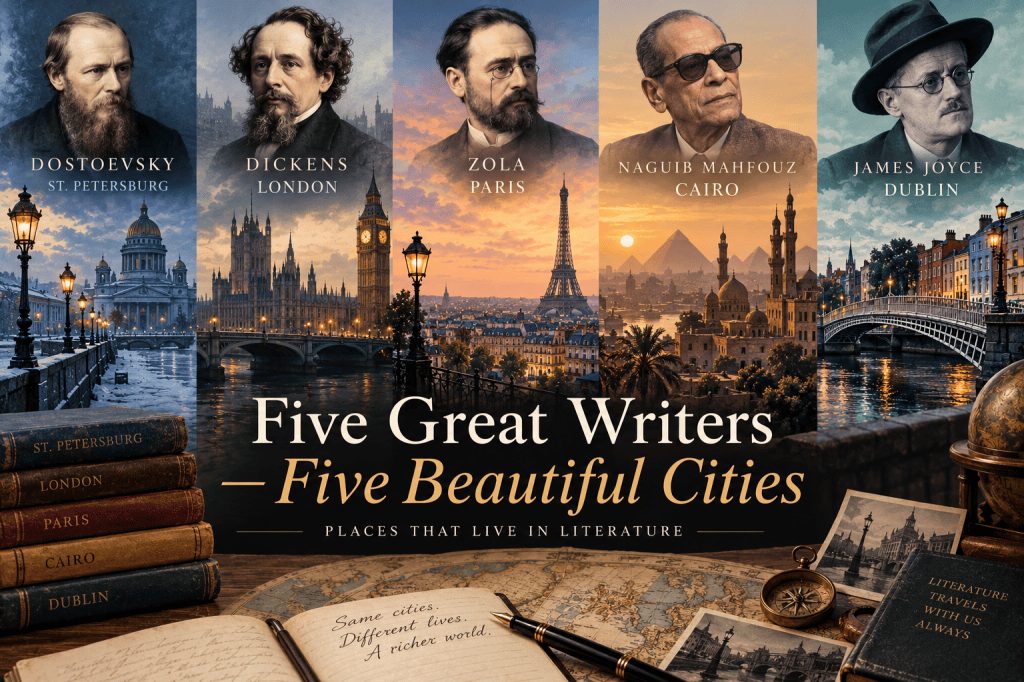
Few writers have captured this relationship between place and fiction as memorably as Fyodor Dostoevsky, Charles Dickens, Naguib Mahfouz, James Joyce, and Émile Zola. Their works are closely associated with St. Petersburg, London, Cairo, Dublin, and Paris. Each writer portrays a distinct urban world, revealing how the experience of living in a city can be shaped by poverty, class, ambition, memory, and social change.
This does not mean that every work by these authors takes place in one city. Rather, these cities recur in important works and are central to the literary worlds for which the writers are known.
1. Fyodor Dostoevsky – St. Petersburg, Russia
St. Petersburg occupies a central place in the fiction of Fyodor Dostoevsky. Founded by Peter the Great in the early eighteenth century, the city became the setting for several of Dostoevsky’s most influential works. His St. Petersburg is not merely a grand imperial capital. It is also a city of cramped lodgings, crowded streets, poverty, and intense psychological pressure.
In Crime and Punishment, the city is closely tied to the troubled inner life of Rodion Raskolnikov, a former student who commits murder and then struggles with guilt and fear. The novel’s urban setting is concrete and recognisable: its streets, courtyards, taverns, and crowded rooms contribute to the oppressive atmosphere surrounding him. The area around Haymarket Square, known today as Sennaya Ploshchad, is especially associated with the novel’s cityscape.
Dostoevsky’s St. Petersburg is also the setting for The Idiot, in which Prince Myshkin enters a world of wealth, social status, rivalry, and emotional vulnerability. The novel moves through the city’s households and social circles, while nearby Pavlovsk also serves as an important setting. Here, the city’s social life provides the stage for encounters shaped by love, ambition, jealousy, and judgment.
A different mood emerges in White Nights, a novella set during St. Petersburg’s luminous summer nights. Its lonely narrator wanders through the city and meets a young woman, beginning a brief and emotionally intense connection. The canals, streets, and twilight atmosphere give the story a dreamlike quality, making the city feel intimate and poetic.
Across these works, St. Petersburg takes on several forms: a place of psychological strain, a setting for social drama, and a landscape of solitude and longing. Dostoevsky’s achievement lies in showing how the same city can contain radically different inner worlds.
2. Charles Dickens – London, England
Charles Dickens helped make London one of the most recognisable cities in English literature. Writing during the nineteenth century, he portrayed a rapidly changing metropolis marked by industrial growth, crowded neighbourhoods, stark inequalities, and powerful institutions. His London is not a single, uniform place. It is a collection of contrasting worlds, from poor streets and workhouses to respectable homes and wealthy establishments.
In Oliver Twist, Dickens depicts the vulnerability of poor children and the harsh conditions surrounding poverty and crime. London’s streets and institutions form the setting for Oliver’s experiences, exposing the distance between the city’s respectable appearance and the hardships faced by many of its inhabitants.
Bleak House offers another portrait of the city, this time through the legal system and the social networks surrounding it. London’s fog, streets, offices, and homes contribute to the novel’s atmosphere of confusion and delay. The city becomes closely associated with the effects of bureaucracy and the unequal distribution of power.
In Our Mutual Friend, Dickens explores money, inheritance, social ambition, and class. The river, streets, and households of London connect characters from different social backgrounds, while the pursuit of wealth influences their relationships and choices.
Dickens’s London is memorable because it feels alive with movement and contradiction. It can be energetic and full of opportunity, yet also exhausting and unforgiving. Through its streets and institutions, Dickens examines the human consequences of social inequality and the moral responsibilities of a modern city.
3. Naguib Mahfouz – Cairo, Egypt
For Naguib Mahfouz, Cairo was both a home city and a major source of literary material. His fiction offers detailed portraits of its neighbourhoods, families, cafés, and changing social life. Across his work, Cairo appears not as an abstract symbol but as a lived environment, shaped by ordinary routines as well as political and historical change.
In Midaq Alley, Mahfouz focuses on a small Cairo alley and the people who live and work there. The residents have different hopes and ambitions, and their lives are affected by economic hardship, social expectations, and the changes taking place beyond their neighbourhood. The alley creates a concentrated setting in which private desires meet the pressures of the wider city.
The Cairo Trilogy beginning with Palace Walk, followed by Palace of Desire and Sugar Street offers a broader view of family and society in Cairo during the early twentieth century. The novels follow several generations of one family, tracing changes in domestic life, social values, and political awareness. The city’s streets and households become part of a larger portrait of Egyptian society in transition.
In The Thief and the Dogs, Cairo provides the setting for Said Mahran’s return from prison and his attempts to confront those he believes have betrayed him. The city’s changing social landscape forms the backdrop to his isolation and pursuit of revenge.
Mahfouz’s Cairo is made vivid through close observation of everyday life. His characters inhabit particular streets and communities, but their concerns – family, dignity, money, love, and belonging reach beyond the city itself. His fiction shows how the intimate scale of a neighbourhood can illuminate the wider transformations of a society.
4. James Joyce – Dublin, Ireland
James Joyce’s writing is inseparable from Dublin. Although he spent much of his adult life outside Ireland, the city remained a central imaginative landscape in his work. Joyce paid close attention to Dublin’s streets, buildings, speech, habits, and social customs, creating fiction in which the ordinary details of urban life carry considerable meaning.
His novel Ulysses takes place primarily in Dublin on 16 June 1904. It follows Leopold Bloom, Stephen Dedalus, and other characters as they move through the city during the day. Dublin’s streets, businesses, pubs, and public spaces are not incidental scenery: they organise the characters’ movements and give the novel its distinctive sense of place. Joyce’s detailed use of real locations has also made the city an enduring point of interest for readers.
In A Portrait of the Artist as a Young Man, Dublin forms an important part of Stephen Dedalus’s developing world. The novel follows Stephen’s intellectual and artistic growth, including his changing relationship with family, education, religion, and Ireland. While the story also includes settings beyond the city, Dublin remains closely connected to the experiences that shape him.
Joyce’s Dubliners, a collection of short stories rather than a novel, further demonstrates his commitment to the city. Its stories portray people from different walks of life and explore the routines, frustrations, hopes, and constraints of urban existence.
Joyce’s Dublin is built from everyday encounters rather than grand description alone. A walk across town, a conversation, or a familiar street can reveal a character’s private thoughts and social position. By observing the city with such precision, Joyce transformed Dublin into one of the most distinctive urban settings in modern literature.
5. Émile Zola – Paris, France
Émile Zola’s novels offer a vivid record of Paris during a period of major urban and social transformation. In the nineteenth century, Paris underwent extensive redevelopment, including the construction of broad boulevards and changes to its neighbourhoods. Zola’s fiction explores the city through its markets, shops, theatres, streets, and social hierarchies.
In The Belly of Paris (Le Ventre de Paris), the central setting is the great market district of Les Halles. The novel follows Florent, a political exile who returns to Paris and becomes involved in the world of the markets. Zola uses the abundance of food and the bustle of market life to create a richly sensory portrait of the city. The market is also a social environment in which prosperity, hunger, political suspicion, and personal rivalries intersect.
The Kill (La Curée) portrays wealth, speculation, and social ambition in Paris during the Second Empire. Its characters move through a world shaped by property, money, and the city’s transformation. The novel connects private desire with the wider changes taking place in the capital.
In Nana, Zola explores Parisian theatre and high society through the rise of Nana, an actress and courtesan. The city’s entertainment culture and social circles become central to the novel’s examination of wealth, desire, and reputation.
Zola’s Paris is both a physical city and a network of social forces. Markets, theatres, homes, and boulevards reveal how money and status shape people’s lives. His detailed descriptions make the city tangible, while his characters show the human consequences of its changing social order.
Conclusion: Cities That Become Literary Worlds
St. Petersburg, London, Cairo, Dublin, and Paris are real cities, but in these writers’ hands they become distinctive literary worlds. Dostoevsky’s St. Petersburg holds both psychological torment and romantic solitude. Dickens’s London exposes the inequalities and institutions of Victorian society. Mahfouz’s Cairo brings family and neighbourhood life into focus amid social change. Joyce’s Dublin is rendered through precise attention to everyday experience, while Zola’s Paris reveals the influence of money, class, and urban transformation.
These authors did not write exclusively about one city, nor does every novel by each writer share the same setting. Yet the recurring presence of these places gives their fiction a powerful sense of identity. Their cities help shape the characters, conflicts, and moods of the stories and remain part of what readers remember long after finishing the books.
Five great writers – Five Beautiful cities


Leave a Reply